


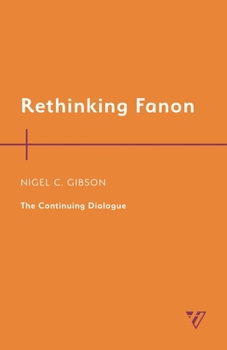
Rethinking Fanon: The Continuing Dialogue

Select Format
Select Condition 
Book Overview
Over sixty years after his death, the social philosopher and psychiatrist Frantz Fanon (1925-1961) remains a towering intellectual figure. Born in Martinique and trained as a psychiatrist in France, Fanon rejected his French citizenship to join the Algerian liberation movement in the 1950s. In the short decade from 1952 to 1961 this brilliant and engaged intellectual composed three books Black Skin, White Masks, A Dying Colonialism, and The Wretched of the Earth, which continue to spur intellectual awakenings across the world.
The rebirth of Fanonism today in universities and the English-speaking world is a testament to his relevance. Edited by distinguished Fanon scholar Nigel C. Gibson, Rethinking Fanon: The Continuing Dialogue, first published in 1999, has become a classic, grounding new discussions of Fanon and cultural, postcolonial, Africana and gender studies with earlier African and African American dialogues. The bookopens with an authoritative biography by the Ghanaian political scientist Emmanuel Hansen, which corrects fallacious assertions about Fanon's life, situating him in Marxism, Negritude, Pan-Africanism, and the historical context of postwar decolonization, specifically the Algerian revolution. Section one is highlighted by extended discussions of Fanon's theories on revolution and "true liberation," including Fanon's revolutionary psychiatry by Hussein A. Bulhan, now the President of the Frantz Fanon University, and discussions of Fanon's dialectic of liberation by African American theorist Tony Martin, and Marxist-Humanists, John Alan and Lou Turner. The next section examines Fanon's re-emergence in postcolonial studies in British and American universities with now classic chapters by Homi K. Bhabha, Henry Louis Gates Jr., Edward W. Said and Benita Parry. The third section, "Fanon, Gender, and National Consciousness" includes chapters by Anne McClintock, Diana Fuss and T. Denean Sharpley-Whiting remain important to the ongoing debates about identity and agency. This excellent collection reflects the continuing impact of Fanon's thought on Africana studies, feminism and sexuality studies, postcolonialism, decolonial, and cultural studies.Format:Paperback
Language:English
ISBN:1538172496
ISBN13:9781538172490
Release Date:September 2022
Publisher:Humanities Press Intl
Length:466 Pages
Weight:1.30 lbs.
Dimensions:1.0" x 5.5" x 8.5"
Customer Reviews
2 ratings
Important collection if essays on Frantz Fanon
Published by Thriftbooks.com User , 23 years ago
Anyone interested in Frantz Fanon and post colonial studies would do well to start here. This well rounded critical volume discusses Fanon's thought and its contexts as well as current debates. The collection includes essays by Said, Gates, Bhabha, McClintock and Fuss as well as important essays by less well known authors including Bulhan, Sharpley-Whiting, Gibson (who also writes a provocative introduction) and Turner. It has a good number of essays on the debates around Fanon and Feminism. 460 pages at this price, it's a deal.
Frantz Fanon and his legacy
Published by Thriftbooks.com User , 25 years ago
Forged in the colonialism of Martinique, confirmed by the racism of Paris and vividly enlivened by the Algerian revolution, Frantz Fanon's all too brief life (1925-1961) and thought were inextricably linked to the transformation of reality. Fanon's historical importance as a Black theorist with a total critique of imperialism has made him a crucial figure in the Black struggles in the U.S., the fight against apartheid in South Africa and postcolonial theory. RETHINKING FANON: THE CONTINUING DIALOGUE is a new collection of essays, edited by Nigel Gibson, which highlights Fanon's significance by airing controversies over his legacy. The issues which generate the most controversy concern the meaning of Fanon's humanism and his assessment of the role of women in the Algerian revolution. The two issues are intimately linked. Fanon's famous critique of "The Pitfalls of National Consciousness" outlines the ways in which a revolution can stop short or turn into its opposite if a narrow vision of the past is imposed as a substitute for the ongoing development of a new culture. In one of the most moving pieces in the collection, Algerian feminist Marie-Aimée Helie-Lucas relates the hideous damage done by delaying women's liberation until after the revolution. The building of a "national culture" falls disproportionately on women, who become symbolic carriers of traditions which are "seen as ahistorical and immutable" (275). "Defending women's rights 'now'-this now being any historical moment-is always a betrayal of the people, the nation, the revolution, religion, national identity, cultural roots" (280). Helie-Lucas holds Fanon partly responsible for this bind in which women were placed after the revolution, claiming that he created a myth of Algerian women's "revolutionary virtue of the veil" (275). T. Denean Sharpley-Whiting considers this argument, but rejects it, saying that Fanon was not trying to make a stagnant principle out of the veil. Instead, he was dialectically recording a fluid revolutionary situation, relating "Algerian women's resistance in a way that can be remembered, recalled, and corrected by women in their present quests for self-actualization" (350). The debate on women's liberation is the most exciting section of the book, framed as it is by the voices of Algerian women liberationists. Zouligha, described as an activist, writes movingly of the silences that pervade an Algeria terrorized by armed Islamist groups, but she warns that it is not enough to simply oppose religious fundamentalism. Those "women's associations who limited themselves to the struggle against the Islamists ended up allying themselves with the state power" (366). A NEW HUMANISM The issues Zouligha raises are key to understanding the dialectic of revolution for which Fanon was reaching. As Nigel Gibson writes, "in contrast to an 'Islamic' nation, Fanon posited not simply secularism but a 'new humanism'" (29). This concept is taken up by Lou Turner and John Alan in
Copyright © 2026 Thriftbooks.com Terms of Use
| Privacy Policy | Do Not
Sell/Share My Personal Information | Cookie Policy | Cookie Preferences | Accessibility Statement
ThriftBooks® and the ThriftBooks® logo are registered trademarks of Thrift Books Global, LLC
ThriftBooks® and the ThriftBooks® logo are registered trademarks of Thrift Books Global, LLC
