


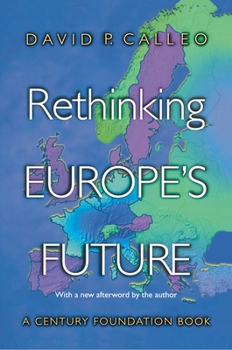
Rethinking Europe's Future


Select Format
Select Condition 
Book Overview
Revised
Format:Paperback
Language:English
ISBN:069111367X
ISBN13:9780691113678
Release Date:March 2003
Publisher:Princeton University Press
Length:416 Pages
Weight:1.28 lbs.
Dimensions:1.1" x 6.0" x 9.3"
Customer Reviews
1 rating
Book Review: Rethinking Europe's Future
Published by Thriftbooks.com User , 23 years ago
In his book, Rethinking Europe?s Future, David P. Calleo encapsulates the history, theory, and reasoning behind Europe?s struggle for peaceful inter-state relations and presents new ideas for Europe?s future course. In three parts, encompassing sixteen chapters, he covers a wide variety of topics from economic theory, international relations theory, to history and the role of complex inter-dependence. Of note is his discourse on the past, present, and future of the North Atlantic Treaty Organization, NATO, and the European Union?s (EU?s) quest for a Common Foreign and Security Policy, CFSP. Furthermore, his work is strongly supported by many past, and recent, historical case studies that impacted Europe?s course, and still linger in the minds of present day decision- makers.Part 1, Europe?s Living History, covers the gambit of Europe?s violent history from the wars of Napoleon and German Unification, through World War I and II. In this part, Calleo outlines the multi-faceted causes of Europe?s most violent wars and relates them to economics, and to both the development and implementation of international-relations theory nested within economic theory. This is a truly remarkable feat, as well as a good review of both economic and basic international relations theory, as it is written in a manner that a novice could follow. Part 2, Legacies of the Cold War, outlines, as the title implies, the interstate system that developed in the after-math of World War II, as well as explores the development of NATO and the role of Unites States (US) hegemony in both European and global affairs. To this end, the author discusses in detail the effects of bi-polar action, America vs. the Soviet Union, as well as the effects of globalization on both Europe and the world political economy. He then synthesizes these into a very coherent concluding chapter, Cold War Lessons, Old and New. Of note in this chapter, is Calleo?s discourse on Gaullist policy and decision-making, and the fact that in the present day EU, state sovereignty is stronger because of the Gaullist legacy.Part 3, The New Europe, covers old, as well as new paradigms for the future Europe, as well as the role of the US and Russia within them. As with most contemporary authors, he asserts that not one paradigm, but multiple paradigms, must be applied to discern Europe?s future, as well as the future of NATO (in particular the US) and Russia in regards to both Europe and Asia. To this end, he asserts that Europe must make accord with both the US (NATO) and Russia, and that the US must redefine its involvement within European affairs, as well as with Russia and Asia. Furthermore, the EU, Russia, and the US must find some common policy in dealing with Asia (China, in particular) that encompasses both security and economic affairs.In short, Rethinking Europe?s Future is a powerful book that synthesizes the writings of many scholars into a short and easily understandable work that is both nested
Copyright © 2026 Thriftbooks.com
Terms of Use | Privacy Policy | Do Not Sell/Share My Personal Information | Cookie Notice | Cookie Preferences | Accessibility Statement
ThriftBooks ® and the ThriftBooks ® logo are registered trademarks of Thrift Books Global, LLC
ThriftBooks ® and the ThriftBooks ® logo are registered trademarks of Thrift Books Global, LLC
