


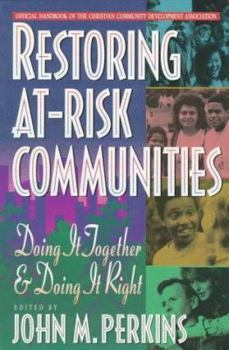
Restoring At-Risk Communities: Doing It Together and Doing It Right

Select Format
Select Condition 
Book Overview
A comprehensive handbook to urban ministry introduces and shows how to implement a Christian community development program.
Format:Paperback
Language:English
ISBN:080105463X
ISBN13:9780801054631
Release Date:February 1996
Publisher:Baker Books
Length:266 Pages
Weight:1.00 lbs.
Dimensions:0.7" x 6.1" x 9.1"
Age Range:15 years and up
Grade Range:Grade 10
Customer Reviews
4 ratings
Doing it Together & Doing it Right
Published by Thriftbooks.com User , 21 years ago
Restoring At-Risk Communities, the official handbook of the "Christian Community Development Association", is a very insightful and practical "tool" and "testimonial" that informs it's readers of how to "appropriately" and "successful" meet the different challenges usually encountered in ministering to urban at risk communities. Edited by the well-informed founder and chairman of the Christian Community Development himself, John Perkins, he as well as many others professionals, do a great job sharing and expressing many of their different realities (i.e. racism, poverty, the lack of indigenous leadership) serving underdeveloped communities and the strategies they think are beneficial to aiding them. One of those strategies or concepts in which the book is centered around is "The Three R's"-Relocation, Reconciliation, and Redistribution. Relocation deals with the need for the people of God to live and work in the communities among the people that they are attempting to serve and bring to the gospel to; Reconciliation deals with having individuals (servants and the served) loving God and loving their "neighbors" as themselves; and Redistribution, deals with the people of God putting their lives, skills, education, and resources to work, in order to empower the people in the community of need. All of which should help promote "wholistic ministry"(Evangelism and Social action), as well as address the "Three Universal Needs" usually unmet in undeveloped communities, "the need to belong", "the need to be significant and important", and "the need for a reasonable amount of security". In the manner of eleven chapters and two hundred and sixty-six pages, this enlightening guidebook and manual also explains what Christian Community Development is (a model and concept created by the grassroot workers of different church based efforts, who have seen themselves as the agents of Christ, providing long-term solutions to the problems facing undeveloped communities, through the application of practical biblical principals), its transformational effectiveness, its necessary principles for its introduction into "underserved' communities (The Three R's- Relocation, Reconciliation, and Redistribution), its relationship to the church, its development of indigenous leaders (those already native leaders within the inner-city communities that are in need of development), and how to have families become part of the work of those participating within its ministry. If you are considering ministry within the city, or if your are already doing ministry within an urban community, Restoring At-Risk Communities is an excellent and affordable buy, that will be a blessing to you, your ministry, those that you serve with, and those that you serve in the urban community.
Maple Syrup for the inner city
Published by Thriftbooks.com User , 21 years ago
The writings in this book are from a perspective of Christian action that has adopted an approach towards mission guided by the themes of relocation, reconciliation, and redistribution. By focusing their energy on these principles the contributors to this book labor against the societal structures that keep people oppressed. The book is a collection of writings from individuals who have real experience in what they are writing about. This book is not in the realm of theory, but of reality. The fact that it is written by so many authors in different situations also highlights the fact that this purpose of Christian community development can (and must) manifest in various forms and can still be consistent in motivation and goal. This opens up the potential for replication of intent in the differing areas God calls us. Instead of offering merely a map to community development, the testimonials illustrated the total life commitment necessary to follow Jesus into this type of work and advise us to count the cost. The book does not paint a rosy picture of urban ministry! A life of this ministry is self and family sacrificial. A life of this ministry is dangerous. A life of this ministry is not going to be easy-physically, mentally, or spiritually. This book is filled with real life stories of urban ministers who pass on their stories with the intent to inform and inspire. What separates this book from others that attempt to outline community development is a focus on racial reconciliation. This is important because the idea of the fast paced homogenous church is very alluring, but this is at the expense of the opportunity to show that Christianity is the tool that can break the wall of separation between races. It is also important in America because the racial problem has been swept under the rug and now manifests in more subtle and often just as painful forms. This book admits that true racial reconciliation has not occurred in America, offers Christianity as the tool to shatter the separation, and then shows real life examples of personal and structural racial reconciliation through conscious and intentional Christian action. If you agree with the following quote by John Perkins, then this book is for you: "The desperate conditions that face the poor call for a revolution in our attempts at a solution... these desperate problems cannot be solved without strong commitment and risky actions on the part of ordinary Christians with heroic faith."
Getting Started in Urban Ministry
Published by Thriftbooks.com User , 21 years ago
This is a collection of essays by people who have applied the ideas of Christian community development to their own ministries. Their various perspectives and stories provide a basic understanding of what Christian community development is, what it requires from those who hope to use its strategies, and some simple suggestions for putting the strategies into practice. This book is helpful because it provides theories as well as stories from people who put the principles into action. New church planters can use it as a handbook full of guiding principles, and those who are already involved in urban ministry can use it as a source of encouragement and to get new ideas. One thing I find beneficial about this book is that before it talks about how to fix the problems in at-risk communities, it explains what the problems are and why they exist. I find it especially helpful that the idea of broken community presented in this book is very objective. Individual irresponsibility is addressed as one possible reason for a person's poverty, but it is pointed out that societal injustice can be just as much to blame. Biblical as well as modern-day examples are given as illustrations. The "three Rs"-relocation, reconciliation, and redistribution-are central to the practice of Christian community development. Not everyone who reads this book will agree that these ideas are as important as they are made out to be, but I find it very hard to argue with strategies that are not only based on scripture, but that have also been tested and found effective on many occasions over the last several decades. This book is not perfect. African-American issues are well represented, but issues dealing with Hispanics, Asians, and other growing minorities are almost completely ignored. However, this is probably because Perkins himself is black, and for that reason the fault can be easily overlooked-he simply speaks in the area where he is most familiar. The strategies are broad enough that they can still be applied in various contexts. I strongly recommend this book for anyone seeking to plant a new church in any urban or at-risk context. As the urban situation continues to worsen, stronger and bolder methods of ministry must be used in order to reach those who are hurting. The ideas presented in this book are bold and pro-active, and most importantly, I believe they take their root in the Word of God.
A Missiological Must
Published by Thriftbooks.com User , 22 years ago
Many authors and editors have constructed texts on the who, what, how, and why of inner city/urban ministry, but Perkins' compilation is a must-read for anyone aspiring to reach underprivileged communities. The information offered to the reader is quite general, and allows for flexibility when considering mission planning and strategy. At the same time, it dares those who consider themselves "called to urban work." Perkins lays out a convicting methodology in his tri-fold approach to urban ministry. His exposition of the need for relocation, reconciliation, and redistribution nearly drives the reader to the conclusion that effective service in the at-risk context can not happen outside of these elements of strategy. His argument is incredibly convincing and is obviously backed by several experientially-tested co-authors. The book is written from a vast spectrum of perspectives. The content spans from theological reasoning and standpoint, to the simple, yet profound reminder for ministers to serve their husbands/wives and children. As supporters of the Christian Community Development Association, these writers hold no qualms about articulating the need to edify and create similar programs in the nation's communities. Whereas several other urban missiologists write from an international vantage, Perkins primarily keeps his message within American walls. Nevertheless, the information provided is pertinent to any urban context across the globe. The commonalities of poverty, leadership development, and the local church are addressed - making this text one of value for most ministers of the city. While projecting a foundational theology that seeks to meet spiritual needs, Perkins proposes a strategy for missionaries and teams that include the book's major themes of relocation, reconciliation, and redistribution. In the midst of defining and promoting Christian community, the necessity of indigenous leadership and partnering with the local church, Perkins maintains a tone of `3R' tactic. Due to a lack of Christian disciples in the city, the book heavily pushes for avoidance of urban flight, while advocating relocation to the heart of town. In addition, the editor believes that a failure to redistribute resources, time, and the Gospel back into the lives of the ghettos and slums will yield a continued hopelessness in the hearts of the city's residents. And at the crux of the matter, the reader is encouraged to ruminate upon the significance of reconciliation (God-to-person and person-to-person) for reaching the goal of meeting needs and building the Lord's church in the city. Perkins' concern is the establishment of Christian presence in the hurting communities of America. He and his co-writers are well aware of the social gospel, but their motivation is for the spreading of the Good News to transform the spirit of the urban world - above and beyond providing for temporal needs. For the novice, the book serves to expose and inform. For the expert
Copyright © 2025 Thriftbooks.com
Terms of Use | Privacy Policy | Do Not Sell/Share My Personal Information | Cookie Policy | Cookie Preferences | Accessibility Statement
ThriftBooks ® and the ThriftBooks ® logo are registered trademarks of Thrift Books Global, LLC
ThriftBooks ® and the ThriftBooks ® logo are registered trademarks of Thrift Books Global, LLC
