


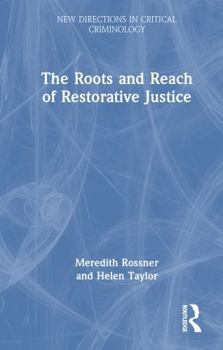
The Roots and Reach of Restorative Justice

Restorative justice brings together those affected by harm to speak, listen, and repair. Over three decades it has spread from a handful of experiments to a practice written into law and policy across most of the world. That success raises a new question: what allows restorative justice movements not just to grow, but to take root and flourish?
Meredith Rossner and Helen Taylor answer this using the metaphor of a garden. A single restorative conference is a ritual encounter that, like a seed, needs the right conditions to grow: the people, organisations, and political climate around it. The book follows that growth from the pioneering experiments of 1970s North America to the foundational developments of the 1990s, including the emergence of restorative justice in New Zealand's youth justice reforms and foundational Australian research into its effectiveness. From there it traces the move to the institutionalised programmes of today. A central case is Northern Ireland, where restorative justice grew from communities seeking alternatives to paramilitary violence and from a state pursuing institutional reform. The book then turns to the field's emerging, most contested frontiers: domestic, family and sexual violence, environmental harm, and hate crime. The result is a fresh way of understanding how restorative justice spreads, where it stalls, and what it would take to flourish.
This book will be of interest to restorative justice practitioners, criminology and criminal justice scholars, policy makers, and community organisations. It provides essential insights for anyone studying, implementing, or advocating for restorative approaches to harm and conflict resolution.
Customer Reviews
ThriftBooks ® and the ThriftBooks ® logo are registered trademarks of Thrift Books Global, LLC
