


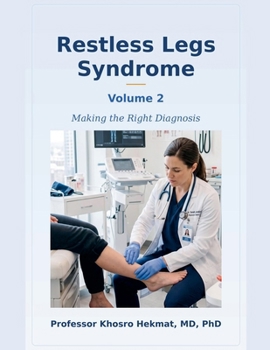
Restless Legs Syndrome - Making the Right Diagnosis

Do I even have this - and how would anyone tell?
There is no blood test, no image and no measurement that proves restless legs syndrome on its own. The diagnosis is clinical and rests on five criteria that a doctor assesses. In one family study, 16% of people judged not to have the condition still met the four old criteria, which is why a fifth criterion, the careful exclusion of look-alike conditions, was added in 2014.
This volume takes the five criteria apart one by one and explains why each of them is needed. It sets them against the conditions that produce the same answers - calf cramps, nerve damage, vein disorders, back problems and drug side effects - and shows how they can be told apart.
For every test that may be offered, it shows what the studies say and where their limits lie: what the sleep laboratory genuinely contributes, what the leg movements in sleep say, what the immobilisation test achieves, and why the levodopa tablet test is a diagnostic aid, not a confirmation.
WHAT IS IN THE BOOK
- The five diagnostic criteria explained one at a time, with their accuracy in figures
- Why four criteria were not enough, and what a fifth adds
- The most important mimics and how to recognise them
- What blood count, sleep laboratory, ultrasound, MRI and nerve conduction achieve
- Diagnosis in children, in pregnancy, on dialysis and in Parkinson's disease
- How to tell when the treatment itself is producing the symptoms
- What belongs in the medical conversation so that the right diagnosis is reached
WHO THIS BOOK IS FOR
For patients without a secure diagnosis, for everyone whose test results came back unremarkable while the symptoms did not, and for relatives who want to follow the diagnostic path.
ABOUT THE SERIES
Volume 2 of 52 in the book series on restless legs syndrome, part "Foundations". Every volume can be read on its own. The statements in this volume rest on 302 professional sources, each one listed individually in the reference section.
Customer Reviews
ThriftBooks ® and the ThriftBooks ® logo are registered trademarks of Thrift Books Global, LLC
