


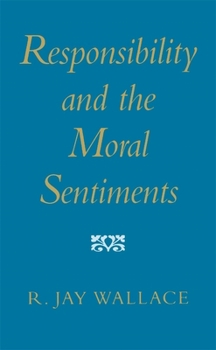
Responsibility and the Moral Sentiments

Select Format
Select Condition 
Book Overview
R. Jay Wallace advances a powerful and sustained argument against the common view that accountability requires freedom of will. Instead, he maintains, the fairness of holding people responsible depends on their rational competence: the power to grasp moral reasons and to control their behavior accordingly. He shows how these forms of rational competence are compatible with determinism. At the same time, giving serious consideration to incompatibilist concerns, Wallace develops a compelling diagnosis of the common assumption that freedom is necessary for responsibility.
Format:Paperback
Language:English
ISBN:0674766237
ISBN13:9780674766235
Release Date:January 1998
Publisher:Harvard University Press
Length:288 Pages
Weight:0.80 lbs.
Dimensions:0.7" x 6.1" x 9.2"
Customer Reviews
1 rating
It's Original and Stimulating
Published by Thriftbooks.com User , 25 years ago
This is an outstanding book. It is not, however, a beginner's book and will be appreciated best by those already familiar with the field. Two of its most interesting claims are as follows. First, that emotions are constitutive of the practice of holding people morally responsible. That is, to say what it is to hold someone morally responsible--to blame someone, for instance--one must make reference to the emotions of the person who is holding the other responsible. To blame someone for something necessarily involves feeling appropriate emotions like resentment or indignation for the other's failure to live up to one's expectations regarding moral behavior. Or, if one does not actually feel resentment (as when one forgives someone whom one regards as morally responsible and blameworthy), one must at least think that feeling such an emotion would be justified. Second, the author contends that in order to be responsible for something, the responsible party need not have had any alternate possibilities to the blameworthy or praiseworthy action. This claim is supported by a detailed examination of the grounds for excuses and exemptions from moral responsibility. We exempt people from moral responsibility because they lack the capacities necessary for it, and we excuse people from moral responsibility because what they did or failed to do lacked moral fault. This sometimes, but not always, coincides with the absence of alternate possibilities for action, but it is lack of capacity or absence of fault, not absence of alternate possibility, that explains the exemption or excuse. This is a careful and stimulating study by a scholar who has mastered the literature in the field. It is likely to have a deep impact on philosophical thinking about freedom and responsibility.
Copyright © 2026 Thriftbooks.com
Terms of Use | Privacy Policy | Do Not Sell/Share My Personal Information | Cookie Policy | Cookie Preferences | Accessibility Statement
ThriftBooks ® and the ThriftBooks ® logo are registered trademarks of Thrift Books Global, LLC
ThriftBooks ® and the ThriftBooks ® logo are registered trademarks of Thrift Books Global, LLC
