


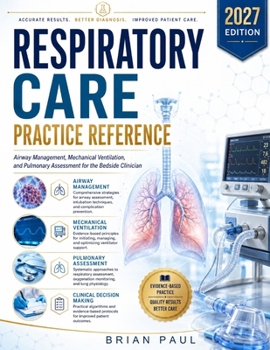
Respiratory Care Practice Reference: Airway Management, Mechanical Ventilation, and Pulmonary Assessment for the Bedside Clinician
No Customer Reviews

Written for respiratory therapists, critical care and emergency nurses, paramedics, physician assistants, and students entering clinical rotations, it covers the full arc of respiratory practice, from first assessment through advanced airway control and long-term ventilator management, in plain and in-depth clinical language.
What this reference coversPulmonary assessment - inspection, palpation, percussion and auscultation, breath sound interpretation, work-of-breathing patterns, and the physical findings that change management.Oxygenation and gas exchange - delivery devices, humidification, high-flow nasal cannula, and the physiology behind shunt, dead space and V/Q mismatch.Arterial blood gas interpretation - a repeatable stepwise method for acid-base disorders, compensation and mixed disturbances, with worked clinical examples.Airway management - positioning and basic maneuvers, supraglottic devices, endotracheal intubation, difficult airway planning, surgical airway considerations, and tube confirmation and securement.Mechanical ventilation - modes explained by what they actually do, initial setup logic, volume versus pressure control, PEEP and recruitment, lung-protective strategy, and waveform and graphics interpretation.Troubleshooting - the alarming ventilator, patient-ventilator dyssynchrony, auto-PEEP, sudden desaturation, and a structured approach to the deteriorating intubated patient.Weaning and liberation - readiness assessment, spontaneous breathing trials, extubation planning, and post-extubation failure.Noninvasive ventilation - CPAP and BiPAP selection, interface fitting, and recognizing the failing NIV trial.Tracheostomy and long-term airways - routine care, cuff management, decannulation, and emergency management of the obstructed or displaced tube.Airway clearance and diagnostics - secretion management, suctioning technique, capnography, and pulmonary function testing.Condition-specific approaches - ARDS, COPD exacerbation, status asthmaticus, pneumonia, pulmonary edema, and the neuromuscular patient.How it is builtExplanation, not description - every technique is grounded in the physiology that makes it work.Diagrams and clinical tables throughout, designed to be read at a glance.Verify Before Use boxes in every chapter, because equipment, protocols and institutional policy vary.Large 8.5 x 11 format with clear typography, sized for a workstation, a shelf or a study table.A note on scope: this reference deliberately contains no drug dosing. Dosing changes, varies by institution, and belongs in your own formulary. What does not change is the clinical reasoning, and that is what this book teaches. This book is an independent publication and is not affiliated with or endorsed by any medical board, certification body, or institution.
Format:Paperback
Language:English
ISBN:B0HHD5JRGQ
ISBN13:9798170693627
Release Date:August 2026
Publisher:Independently Published
Length:366 Pages
Weight:1.87 lbs.
Dimensions:0.8" x 8.5" x 11.0"
Customer Reviews
0 rating
Copyright © 2026 Thriftbooks.com
Terms of Use | Privacy Policy | Do Not Sell/Share My Personal Information | Cookie Notice | Cookie Preferences | Accessibility Statement
ThriftBooks ® and the ThriftBooks ® logo are registered trademarks of Thrift Books Global, LLC
ThriftBooks ® and the ThriftBooks ® logo are registered trademarks of Thrift Books Global, LLC
