


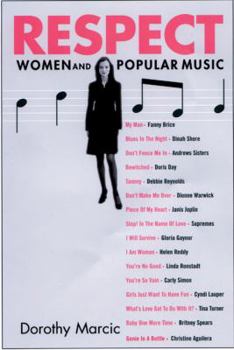
Respect: Women and Popular Music

Select Format
Select Condition 
Book Overview
For more than the first half of the last century, the voice of women in Top-40 popular music has been one of neediness and dependency. Please love me; I'll do anything for you; just be my baby, even... This description may be from another edition of this product.
Format:Hardcover
Language:English
ISBN:1587990830
ISBN13:9781587990830
Release Date:March 2002
Publisher:Texere
Length:259 Pages
Weight:0.85 lbs.
Dimensions:9.5" x 1.3" x 6.5"
Related Subjects
Arts, Music & Photography Business Business & Investing Education Education & Reference Gay & Lesbian Guides History History & Criticism Job Hunting & Careers Music Musical Genres Politics & Social Sciences Schools & Teaching Social Science Social Sciences Theory, Composition & Performance Women's StudiesCustomer Reviews
3 ratings
Put your nostalgia in context!
Published by Thriftbooks.com User , 23 years ago
If you are like me, you grew up listening to popular music, "girl groups" singing catchy melodies, without regard to the cultural or historical context of the tunes. Dorothy Marcic, in a well-researched and documented, highly readable book, has succeeded in placing our nostalgic memories into a larger framework. The political picture, the economic realities, the evolution of female roles are all chronicled by incorporating the popular music that enthralled us over the years. Who knew that the path from "My Man" to "I Will Survive" led us along our own path of liberation and independence. A book that entertains and makes you think at the same time! If you ever get the opportunity to see Dr. Marcic perform and illustrate her material in person, by all means do so! Highly recommended!
An incredible synthesis!
Published by Thriftbooks.com User , 23 years ago
Whether our popular music is a reflection or shaper of culture, it's fascinating to read the lyrics of these songs -- and to see how far we've come over the past century. I really like the way that music is used as a thread for weaving together political and world events, as well as psychology, business, and spirituality. A great read!
Respect: Women and Popular Music
Published by Thriftbooks.com User , 24 years ago
Respect: Women and Popular Music is a powerful book that chronicles the best known music of women in the 20th Century and examines the sociological and personal implications the music had. Marcic masterfully weaves a relationship between the development of the music and the development of women over the century. From the early 1900s, the lyrics of dependency eventually evolve into the powerful lyrics of independence and resolve heard in the late century.A particularly effective feature of the book is the use of personal rememberances about the music. These diverse reflections show how the music enters our hearts and minds -- our consciousness and unconsciousness. This technque further shows how the music not only reflects our roles, but may powerfully influence our roles and may even empower, motivate and affirm us toward change.This is a great book for anyone who wants to take a deeper and different look at the development of women and their roles. It presents a new and refreshing perspective, not shown before in the literature about women. After having finished book and being a person who grew up in the fifties and came of age in the sixties, I have to wonder how did we as women ever get past the music messages that we grew up with and become the trailblazers of the women movement?
Copyright © 2026 Thriftbooks.com Terms of Use
| Privacy Policy | Do Not
Sell/Share My Personal Information | Cookie Policy | Cookie Preferences | Accessibility Statement
ThriftBooks® and the ThriftBooks® logo are registered trademarks of Thrift Books Global, LLC
ThriftBooks® and the ThriftBooks® logo are registered trademarks of Thrift Books Global, LLC
