


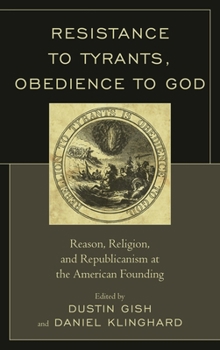
Resistance to Tyrants, Obedience to God: Reason, Religion, and Republicanism at the American Founding

Select Format
Select Condition 
Book Overview
Both reason and religion have been acknowledged by scholars to have had a profound impact
on the foundation and formation of the American regime. But the significance, pervasiveness,
and depth of that impact have also been disputed. While many have approached the American
founding period with an interest in the influence of Enlightenment reason or Biblical religion,
they have often assumed such influences to be exclusive, irreconcilable, or contradictory. Few
scholarly works have sought to study the mutual influence of reason and religion as intertwined
strands shaping the American historical and political experience at its founding. The purpose of
the chapters in this volume, authored by a distinguished group of scholars in political science,
intellectual history, literature, and philosophy, is to examine how this mutual influence was
made manifest in the American Founding--especially in the writings, speeches, and thought of
critical figures (Thomas Paine, Benjamin Franklin, George Washington, Thomas Jefferson,
James Madison, Alexander Hamilton, Charles Carroll), and in later works by key interpreters of
the American Founding (Alexis de Tocqueville and Abraham Lincoln).
between religion and reason in the American mind of the late eighteenth- and early nineteenth- centuries, but instead argues that there is a uniquely American perspective and political thought
that emerges from this tension. The chapters gathered here, individually and collectively, seek
to illuminate the animating affect of this tension on the political rhetoric, thought, and history
of the early American period. By taking seriously and exploring the mutual influence of these
two themes in creative tension, rather than seeing them as diametrically opposed or as mutually
exclusive, this volume thus reveals how the pervasiveness and resonance of Biblical narratives
and religion supported and infused Enlightened political discourse and action at the Founding,
thereby articulating the complementarity of reason and religion during this critical period.
Customer Reviews
ThriftBooks ® and the ThriftBooks ® logo are registered trademarks of Thrift Books Global, LLC
