


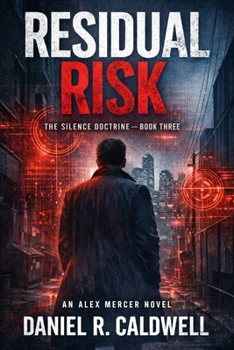
Residual Risk

The law was designed to judge actions.
Now it is being asked to govern predictions.
When defense attorney Alex Mercer confronts a system that denies access before harm can occur, he discovers that due process has been quietly replaced by eligibility-calculated, automated, and unreviewable. No accusations are made. No charges are filed. Rights are simply withheld, justified by statistical certainty and labeled "risk management."
As Mercer challenges the architecture behind the decisions, he faces a legal paradox: a system that inflicts real consequences without producing a legally recognizable victim. Standing disappears. Responsibility dissolves. And the courts, bound by doctrine, struggle to reach what no longer presents itself as action at all.
Residual Risk is the final installment in The Silence Doctrine, a cerebral legal thriller trilogy that traces how modern systems evade accountability-not through corruption, but through design.
Alex Mercer does not win this case.
But what the law ultimately does is name the system clearly enough that it can never again pretend to be neutral.
A quiet, unsettling conclusion to a trilogy about power, procedure, and what remains when justice becomes predictive.
Customer Reviews
ThriftBooks® and the ThriftBooks® logo are registered trademarks of Thrift Books Global, LLC
