


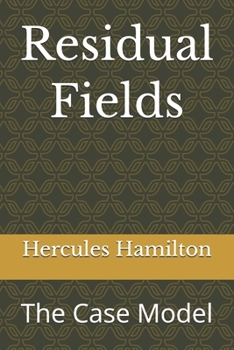
Residual Field: The Case Model

When Caleb Mercer is assigned his first live analytical case, he expects to study behavior patterns across isolated digital profiles. Instead, he begins noticing something that should not be possible: identical structures of interpretation emerging across unrelated people, unrelated contexts, and unrelated timelines.
At first, the anomalies are subtle, delayed engagement spikes, repeated phrasing, mirrored argument structures. But as Caleb moves deeper into the system under the guidance of his supervisor, Elias Crowe, the distinction between individual cases begins to collapse.
What begins as pattern recognition becomes something harder to name: a distributed field of interpretation that behaves as if it remembers itself across every interaction.
As Caleb's ability to separate signal from structure erodes, he is forced to confront a disturbing possibility, not that the system is malfunctioning, but that it is behaving exactly as designed, just at a scale no one fully accounted for.
And the closer he gets to understanding it, the less certain he becomes that he is still observing it from the outside.
Customer Reviews
ThriftBooks ® and the ThriftBooks ® logo are registered trademarks of Thrift Books Global, LLC
