


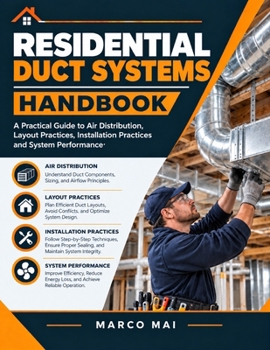
Residential duct systems handbook: A practical guide to Air distribution, layout planning, installation practices and system performance
No Customer Reviews

RESIDENTIAL DUCT SYSTEMS HANDBOOK A well-designed air-distribution network is essential to achieving consistent comfort, heating and cooling, reliable airflow, and dependable HVAC performance throughout a home. When the layout, sizing, sealing, insulation, restricted or balancing is poorly executed, the result can be uneven temperatures, excessive efficient noise, airflow, energy losses, and comfort recurring problems.
Residential Duct Systems Handbook provides a comprehensive practical and introduction to the principles and methods behind effective residential air distribution. Whether you are learning HVAC fundamentals, planning an installation, working with existing equipment, or looking to better understand common airflow problems, this handbook explains the subject in clear, accessible language.
Inside, readers will explore:
- The fundamentals of residential air distribution and airflow
- Supply and return pathways and how they interact with HVAC equipment
- Common components and materials used in residential air-distribution systems
- Reading and understanding basic layouts and HVAC plans
- Room-by-room airflow planning
- Duct-sizing principles, friction, pressure loss, and equivalent length
- Trunk-and-branch, radial, and other layout approaches
- Supply outlet and return-air planning
- Flexible and rigid duct installation considerations
- Connections, fittings, transitions, dampers, grilles, and registers
- Air sealing and leakage control
- Insulation and condensation
- Static pressure and airflow performance
- Balancing and commissioning principles
- Noise, vibration, and uneven-temperature problems
- Maintenance and inspection practices
- Retrofit and remodeling considerations
- Installation quality-control procedures
- Practical troubleshooting using a systematic approach
- Safety considerations for residential HVAC work
- Useful checklists, terminology, calculations, and field-reference material
Rather than focusing only on theory, the book connects fundamental concepts with practical situations. Technical subjects are broken down step by step, with explanations of what a component or method does, why it matters, how it affects performance, and what problems can occur when it is incorrectly applied.
It also addresses an important reality of residential HVAC work: **there is no single duct solution that fits every home.** Building layout, equipment characteristics, climate, construction methods, available space, applicable codes, installation conditions, and manufacturer requirements can all influence the appropriate approach. For that reason, the book emphasizes sound principles, careful planning, verification, and professional judgment rather than arbitrary one-size-fits-all rules.
Whether you are an HVAC student, apprentice, technician, installer, contractor, professional building, or simply someone who wants a deeper understanding of how residential air distribution works, this handbook is designed to provide a practical foundation for understanding, evaluating, and improving residential HVAC airflow systems.
Residential Duct Systems Handbook provides a comprehensive practical and introduction to the principles and methods behind effective residential air distribution. Whether you are learning HVAC fundamentals, planning an installation, working with existing equipment, or looking to better understand common airflow problems, this handbook explains the subject in clear, accessible language.
Inside, readers will explore:
- The fundamentals of residential air distribution and airflow
- Supply and return pathways and how they interact with HVAC equipment
- Common components and materials used in residential air-distribution systems
- Reading and understanding basic layouts and HVAC plans
- Room-by-room airflow planning
- Duct-sizing principles, friction, pressure loss, and equivalent length
- Trunk-and-branch, radial, and other layout approaches
- Supply outlet and return-air planning
- Flexible and rigid duct installation considerations
- Connections, fittings, transitions, dampers, grilles, and registers
- Air sealing and leakage control
- Insulation and condensation
- Static pressure and airflow performance
- Balancing and commissioning principles
- Noise, vibration, and uneven-temperature problems
- Maintenance and inspection practices
- Retrofit and remodeling considerations
- Installation quality-control procedures
- Practical troubleshooting using a systematic approach
- Safety considerations for residential HVAC work
- Useful checklists, terminology, calculations, and field-reference material
Rather than focusing only on theory, the book connects fundamental concepts with practical situations. Technical subjects are broken down step by step, with explanations of what a component or method does, why it matters, how it affects performance, and what problems can occur when it is incorrectly applied.
It also addresses an important reality of residential HVAC work: **there is no single duct solution that fits every home.** Building layout, equipment characteristics, climate, construction methods, available space, applicable codes, installation conditions, and manufacturer requirements can all influence the appropriate approach. For that reason, the book emphasizes sound principles, careful planning, verification, and professional judgment rather than arbitrary one-size-fits-all rules.
Whether you are an HVAC student, apprentice, technician, installer, contractor, professional building, or simply someone who wants a deeper understanding of how residential air distribution works, this handbook is designed to provide a practical foundation for understanding, evaluating, and improving residential HVAC airflow systems.
Format:Paperback
Language:English
ISBN:B0HKM2MF38
ISBN13:9798176277395
Release Date:September 2026
Publisher:Independently published
Length:132 Pages
Weight:0.73 lbs.
Dimensions:11.0" x 0.3" x 8.5"
Customer Reviews
0 rating
Copyright © 2026 Thriftbooks.com
Terms of Use | Privacy Policy | Do Not Sell/Share My Personal Information | Cookie Notice | Cookie Preferences | Accessibility Statement
ThriftBooks ® and the ThriftBooks ® logo are registered trademarks of Thrift Books Global, LLC
ThriftBooks ® and the ThriftBooks ® logo are registered trademarks of Thrift Books Global, LLC
