


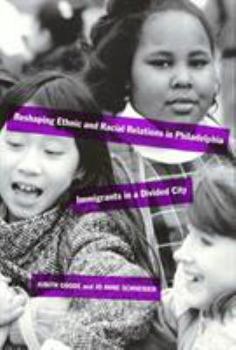
Reshaping Ethnic Relations: Immigrants in a Divided City


Select Format
Select Condition 
Book Overview
What happens when people from diverse racial and ethnic backgrounds come together to live and work in the same neighborhood? This book looks at the interaction of immigrant populations in three... This description may be from another edition of this product.
Format:Paperback
Language:English
ISBN:1566391415
ISBN13:9781566391412
Release Date:May 1994
Publisher:Temple University Press
Length:296 Pages
Weight:1.00 lbs.
Dimensions:0.8" x 6.0" x 8.9"
Customer Reviews
1 rating
The complex nature of inter-ethnic relations
Published by Thriftbooks.com User , 20 years ago
For those lacking a background in anthropology or urban sociology, "Reshaping Ethnic and Racial Relations in Philadelphia" is sure to be a very difficult read and you probably will not like this book. If you can master the heavy use of technical jargon and discourse, this book is very insightful and contains many important points for consideration. Goode and Schneider tackle the issue of inter-ethnic relations in Philadelphia, with a particular emphasis on how new immigrants to the city are impacting and re-defining the nature of race relations. Far too often, "race" in America is perceived in binary, black-white terms. But with three decades of heavy immigration from Latin America and Asia, and with America more diverse than ever before, a black-white dichotomy of race is too limited, too unrealistic, and out of touch with contemporary realities. The authors examine how newcomer immigrants have affected race relations and perceptions of race. One of the authors' key points of argument is that race/ethnic relations are a product of local political, economic, and social structures and historical conditions. In other words, black-white relations (for example) can not be expected to be the same in Baltimore as they would be in Los Angeles, due to vastly different political economies of each city. Even within a particular city, inter-ethnic relations often vary considerably by neighborhood. As part of their argument, the authors present data on fieldwork conducted in three different Philadelphia neighborhoods: Middle-class Olney, working class Port Richmond, and blue-collar Kensington. Another major argument the authors present is a strong criticism of multicultural programs as we know them. All too often, multiculturalism is prescriped as a social engineering antidote for countering prejudice and racial animosity. This takes the form of "diversity training" in the workforce, "multicultural perspectives" courses in colleges, and cultural diversity celebrations such as parades and festivals. Rather than confront the sources of ethnic contention, however, the authors argue that such misguided multiculturalism (despite its admirable intentions) is actually counterproductive and may exacerbate, rather than ameliorate, tensions. Multiculturalism glorifies the "safe" aspects of cultural diversity, such as food, music, art, and dance, while attempting to downplay and sugar coat the actual sources of racial animosity, such as anger over affirmative action, immigration, hate crimes, and changing demographics. The authors argue that what society needs most in order to begin to heal racial and ethnic tension is honest, open dialogue that does not rely on typical cliches of multiculturalist essentialism. The authors provide plenty of empirical evidence to support their arguments throughout the book, which is based off of two years of intense ethnographic study in the three neighborhoods. Many books have attempted to address racial tensions in American socie
Copyright © 2025 Thriftbooks.com
Terms of Use | Privacy Policy | Do Not Sell/Share My Personal Information | Cookie Policy | Cookie Preferences | Accessibility Statement
ThriftBooks ® and the ThriftBooks ® logo are registered trademarks of Thrift Books Global, LLC
ThriftBooks ® and the ThriftBooks ® logo are registered trademarks of Thrift Books Global, LLC
