


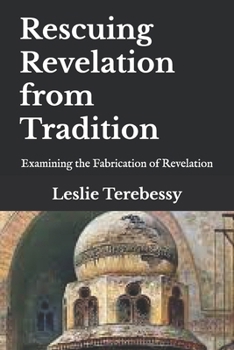
Rescuing Revelation from Tradition: Examining the Fabrication of Revelation
No Customer Reviews

Revelation - the verbatim word of God - is recorded in the Book of Allah. Revelation is the truth from God, the "furqan" for differentiating truth from falsehood, right from wrong, and the adjudication of all disagreements. Revelation established tradition in its wake. Tradition is revelation in practice. Tradition is expected to follow and reflect revelation. Regrettably, this does not always transpire. For as in sister faiths, tradition in Islam veered from revelation. How did this happen? Hawkish rulers required a re-interpretation of revelation to justify wars of aggression. Mercenary ulama stepped up to the challenge. They provided a "re-interpretation" of revelation that furnished the required "religious" justification for waging unlawful wars of aggression lawful. They realised this feat by recourse to the teaching of the abrogation of the verses of reconciliation by the verses of the sword. Unfortunately, in the process of the re-interpretation of revelation, they parted with the teaching of revelation. They defied its teaching and corrupted exegesis and jurisprudence by engaging them to further the political agendas of the ruling elites. In a brazen defiance of the teaching of revelation, mercenary ulama wars of aggression not just lawful but as a requirement of the faith, a sixth pillar of Islam. They permitted what Allah prohibited. The justification of jihad al-talab and its treatment as a sixth pillar of the faith was buttressed by recourse to tradition. The repression of reason assisted in the realization of both events. The repression of reason was justified by recourse to a tradition in which the prophet allegedly equated the use of reason-based tafsir with kufr. The repression of reason found a political expression in the massacre of five-thousand philosophers by Musa al-Hadi in 786, during the first part of the mihna (Inquisition) initiated by his father al-Mahdi in 780. The turn to tradition was justified by the assertion that tradition, too, is revelation and thus also a "root of legislation." Tradition ascended further to a "judge" of revelation, with the "authority" to "abrogate" and "replace" parts of revelation. This transpired with the rulings on apostasy and adultery. Tradition surpassed revelation. The turn from revelation to tradition detached the umma from the Book of Allah. The separation of the umma from revelation was assisted by the repression of reason. Traditional ulama assert that the traditions are "supplementary" revelation from Allah. This "revelation" is expected to "explain" and "detail" the revelation of the Book of Allah. But the Book presents itself as "clear" and "fully detailed." The treatment of tradition as revelation suggests that the traditions - reports of persons - are "equal" to the words of God. The treatment of tradition as "equal" to revelation took place in defiance of assurances in the Book that Allah has no "equals." The treatment of tradition as revelation conflates the words of God with the words of persons. This flouts the requirement to preserve the pre-eminence of God. The unwarranted association of tradition with revelation tainted all that followed. Jurisprudence could no longer draw reliable inferences. For by making tradition equal to revelation, jurists corrupted exegesis as well as jurisprudence. They deified the reports of transmitters and defied tauhid. The treatment of tradition as revelation defies the prohibition of the fabrication of revelation, spelled out in sura 69, verses 44 to 46. The amalgamation of the words of persons with the words of God "mixed" revelation with the sayings of persons. A few jurists asserted that traditions are a "part of" revelation. The treatment of tradition as a "part of" revelation produced far-reaching effects on the umma. The designation of tradition as revelation tainted the knowledge of revelation. How did this happen? What are the effects of these aberrations?
Format:Paperback
Language:English
ISBN:B093N5VM62
ISBN13:9798745125690
Release Date:April 2021
Publisher:Independently Published
Length:132 Pages
Weight:0.41 lbs.
Dimensions:0.3" x 6.0" x 9.0"
Customer Reviews
0 rating
Copyright © 2026 Thriftbooks.com Terms of Use
| Privacy Policy | Do Not
Sell/Share My Personal Information | Cookie Policy | Cookie Preferences | Accessibility Statement
ThriftBooks® and the ThriftBooks® logo are registered trademarks of Thrift Books Global, LLC
ThriftBooks® and the ThriftBooks® logo are registered trademarks of Thrift Books Global, LLC
