


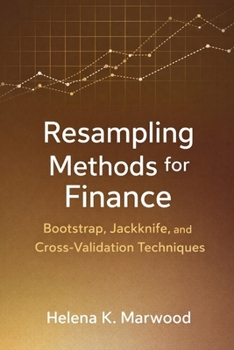
Resampling Methods for Finance: Bootstrap, Jackknife, and Cross-Validation Techniques

Resampling methods have become essential tools in modern quantitative finance, enabling analysts to evaluate model stability, estimate uncertainty, and test strategies when classical assumptions break down. In environments characterized by limited data, non-normal distributions, regime shifts, and structural instability, resampling provides a practical framework for extracting robust statistical insight.
Resampling Methods for Finance presents a rigorous yet applied treatment of bootstrap, jackknife, and cross-validation techniques tailored specifically to financial modeling and empirical research. The book demonstrates how these methods can be used to evaluate portfolio risk, validate predictive models, improve forecasting reliability, and quantify parameter uncertainty across a wide range of financial contexts.
Readers will learn how resampling supports more reliable inference in situations where analytical solutions are unavailable or unreliable, including small sample problems, heteroskedastic data, autocorrelated time series, and complex nonlinear relationships commonly observed in financial markets.
Key topics include:
- Bootstrap methods for confidence intervals, bias estimation, and model stability
- Jackknife techniques for variance estimation and influence diagnostics
- Cross-validation frameworks for model selection and predictive performance assessment
- Applications to asset pricing models, factor analysis, volatility estimation, and risk measurement
- Time series considerations, including block bootstrap and dependence structures
- Practical implementation approaches for empirical finance workflows
The emphasis is placed on methodological clarity and practical applicability, providing quantitative analysts, researchers, and advanced students with a structured foundation for applying resampling techniques in financial settings.
This book is designed for readers working in quantitative finance, econometrics, financial engineering, and data-driven investment research who require reliable statistical tools for evaluating models under real-world data conditions.
Customer Reviews
ThriftBooks ® and the ThriftBooks ® logo are registered trademarks of Thrift Books Global, LLC
