


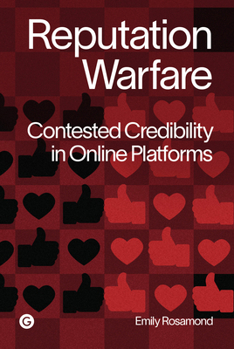
Reputation Warfare: Contested Credibility in Online Platforms

To understand online reputation's fractiousness, a new approach is needed, which analyses how platforms foment long-standing conflicts over reputational value. This book posits that online platforms produce the general opinion: the pervasive sense that it becomes possible to view others' reputations 'in general, ' beyond the bounds of specific social networks; that public discourse becomes broadly oriented toward reputation; and that such generalized expressions of reputation can directly produce financial rewards. However, despite its standardization and quantification, reputation is far too complex to ever be rendered 'in general.' Reputations have long expressed conflicts over the allocation of value to others, and the increasingly standardized display of online reputations only exacerbates this.
This book explores online reputation conflicts, by thinking through how they extend and 'evolve' the complex histories of credit, status, deference and battle that have long inflected how platformed reputations move and matter. It unpacks four online reputation regimes, intersections between the general opinion and conflicts over reputational value informed by long histories of capitalist reputation management. The crowd-sourced credibility regime extends consumer credit scoring histories, inviting online users to think of platformed liking and rating as steps in a crowd-sourced credit scoring algorithm. The microcelebrity regime governs status in the lives of online cultural producers, such as aspiring YouTube stars. It operationalizes status metrics, such as subscriber counts, to distinguish between paid and unpaid online cultural labour. The identity regime extends racial and patriarchal capitalisms, by ascribing users different reputational rewards, costs and risks according to identity categories. The campaigning regime describes the pervasive sense that online reputation must be fought for - whether through acts of online electioneering, public relations efforts, influencer marketing, or everyday social media posts subtly inflected with these protocols. Together, these regimes comprise a widespread state of reputation warfare, in which seemingly trivial battles over status, credibility and influence play a crucial role in shaping politics and public life.
Customer Reviews
ThriftBooks ® and the ThriftBooks ® logo are registered trademarks of Thrift Books Global, LLC
