


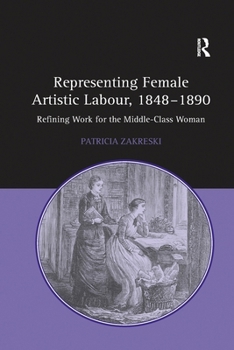
Representing Female Artistic Labour, 1848-1890: Refining Work for the Middle-Class Woman
No Customer Reviews

Select Format
Select Condition 
Book Overview
Patricia Zakreski's interdisciplinary study draws on fiction, prose, painting, and the periodical press to expand and redefine our understanding of women's relationship to paid work during the Victorian period. While the idea of 'separate spheres' has largely gone uncontested by feminist critics studying female labour during the nineteenth century, Zakreski challenges this distinction by showing that the divisions between public and private were, in fact, surprisingly flexible, with homes described as workplaces and workplaces as homes. By combining art with forms of industrial or mass production in representations of the respectable woman worker, writers projected a form of paid creative work that was not violated or profaned by the public world of the market in which it was traded. Looking specifically at sewing, art, writing, and acting, Zakreski shows how these professions increasingly came to be defined as 'artistic' and thus as suitable professions for middle-class women, and argues that the supposedly degrading activity of paid work could be transformed into a refining experience for women. Rather than consigning working women to the margins of patriarchal culture, then, her study shows how representations of creative women, by authors such as Elizabeth Barrett Browning, Dinah Craik, Charles Dickens, Anthony Trollope, and Charlotte Yonge, participated in and shaped new forms of mainstream culture.
Format:Paperback
Language:English
ISBN:1138257249
ISBN13:9781138257245
Release Date:November 2016
Publisher:Routledge
Length:232 Pages
Weight:0.73 lbs.
Dimensions:0.5" x 6.1" x 9.2"
Customer Reviews
0 rating
Copyright © 2026 Thriftbooks.com
Terms of Use | Privacy Policy | Do Not Sell/Share My Personal Information | Cookie Policy | Cookie Preferences | Accessibility Statement
ThriftBooks ® and the ThriftBooks ® logo are registered trademarks of Thrift Books Global, LLC
ThriftBooks ® and the ThriftBooks ® logo are registered trademarks of Thrift Books Global, LLC
