


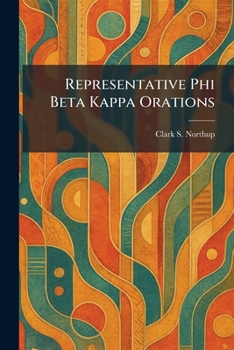
Representative Phi Beta Kappa Orations

Select Format
Select Condition 
Book Overview
"Representative Phi Beta Kappa Orations" is a curated collection of eloquent and thought-provoking addresses delivered before the chapters of the Phi Beta Kappa Society. Edited by Clark S. Northup, this volume preserves some of the most significant intellectual contributions made by American scholars, statesmen, and thinkers during the late 19th and early 20th centuries. The orations featured in this work explore a wide range of themes, including the value of liberal education, the responsibilities of the scholar in a democratic society, and the pursuit of truth and wisdom.
As a testament to the high standards of the nation's oldest academic honor society, these speeches reflect the evolving philosophical and social concerns of the American academic community. Readers will find deep reflections on literature, history, and the moral foundations of leadership. This collection serves not only as a record of rhetorical excellence but also as a profound survey of the intellectual landscape that shaped modern American thought. Whether for students of rhetoric or those interested in the history of ideas, "Representative Phi Beta Kappa Orations" offers a timeless look at the intersection of scholarship and civic duty.
This work has been selected by scholars as being culturally important, and is part of the knowledge base of civilization as we know it. This work was reproduced from the original artifact, and remains as true to the original work as possible. Therefore, you may see the original copyright references, library stamps (as most of these works have been housed in our most important libraries around the world), and other notations in the work.
This work is in the public domain in the United States of America, and possibly other nations. Within the United States, you may freely copy and distribute this work, as no entity (individual or corporate) has a copyright on the body of the work.
As a reproduction of a historical artifact, this work may contain missing or blurred pages, poor pictures, errant marks, etc. Scholars believe, and we concur, that this work is important enough to be preserved, reproduced, and made generally available to the public. We appreciate your support of the preservation process, and thank you for being an important part of keeping this knowledge alive and relevant.
Customer Reviews
ThriftBooks ® and the ThriftBooks ® logo are registered trademarks of Thrift Books Global, LLC
