


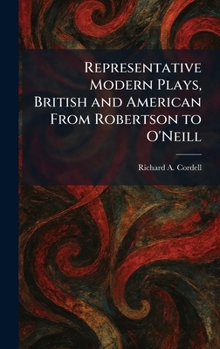
Representative Modern Plays, British and American From Robertson to O'Neill

"Representative Modern Plays, British and American From Robertson to O'Neill" is a comprehensive collection of theatrical works that tracks the evolution of English-language drama from the mid-nineteenth century to the early twentieth century. Curated by Richard A. Cordell, this anthology highlights the transition from traditional theatrical forms to the psychological depth and social realism of the modern stage. By including influential works from both British and American traditions, the volume offers a comparative look at how playwrights on both sides of the Atlantic addressed the shifting cultural landscapes of their time.
The collection spans a pivotal era in dramatic history, beginning with the innovative realism of Robertson and concluding with the groundbreaking expressions of Eugene O'Neill. Readers will encounter a diverse array of styles and themes, reflecting the maturation of the play as a literary and social medium. This anthology serves as an essential resource for students of drama and literature, providing access to foundational plays that defined the modern era. Through these selected works, Cordell illustrates the significant stylistic shifts, character-driven narratives, and social critiques that became the hallmark of twentieth-century theater.
This work has been selected by scholars as being culturally important, and is part of the knowledge base of civilization as we know it. This work was reproduced from the original artifact, and remains as true to the original work as possible. Therefore, you may see the original copyright references, library stamps (as most of these works have been housed in our most important libraries around the world), and other notations in the work.
This work is in the public domain in the United States of America, and possibly other nations. Within the United States, you may freely copy and distribute this work, as no entity (individual or corporate) has a copyright on the body of the work.
As a reproduction of a historical artifact, this work may contain missing or blurred pages, poor pictures, errant marks, etc. Scholars believe, and we concur, that this work is important enough to be preserved, reproduced, and made generally available to the public. We appreciate your support of the preservation process, and thank you for being an important part of keeping this knowledge alive and relevant.
Related Subjects
DramaCustomer Reviews
ThriftBooks ® and the ThriftBooks ® logo are registered trademarks of Thrift Books Global, LLC
