


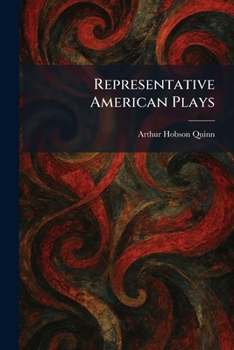
Representative American Plays

Select Format
Select Condition 
Book Overview
"Representative American Plays" is a comprehensive and authoritative anthology that traces the evolution of the American stage from its colonial beginnings through the early twentieth century. Compiled by renowned scholar Arthur Hobson Quinn, this collection showcases the diverse range of dramatic works that have shaped the nation's literary and theatrical landscape.
Featuring a carefully curated selection of plays, the volume offers readers a unique perspective on the shifting social, cultural, and political themes that have preoccupied American playwrights across several generations. From early historical dramas to the emerging realism of the modern era, "Representative American Plays" serves as an essential resource for students, scholars, and enthusiasts of dramatic literature. Each selection highlights a significant moment in the development of a distinctively American voice, providing insight into the techniques and innovations that defined the country's theatrical traditions.
By presenting these works in chronological order, the anthology underscores the progress of American drama from the imitation of European models toward the creation of an independent and vibrant artistic identity. This collection remains a vital touchstone for understanding the history and heritage of the American theatre, preserving the works that defined a genre.
This work has been selected by scholars as being culturally important, and is part of the knowledge base of civilization as we know it. This work was reproduced from the original artifact, and remains as true to the original work as possible. Therefore, you may see the original copyright references, library stamps (as most of these works have been housed in our most important libraries around the world), and other notations in the work.
This work is in the public domain in the United States of America, and possibly other nations. Within the United States, you may freely copy and distribute this work, as no entity (individual or corporate) has a copyright on the body of the work.
As a reproduction of a historical artifact, this work may contain missing or blurred pages, poor pictures, errant marks, etc. Scholars believe, and we concur, that this work is important enough to be preserved, reproduced, and made generally available to the public. We appreciate your support of the preservation process, and thank you for being an important part of keeping this knowledge alive and relevant.
Customer Reviews
ThriftBooks® and the ThriftBooks® logo are registered trademarks of Thrift Books Global, LLC
