


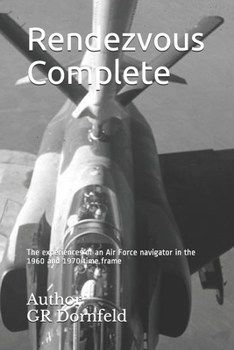
Rendezvous Complete
No Customer Reviews

The purpose of this book is to complement my first book, "Engineer, Set Refueling Power." I tried to bring-in as many personal experiences as I can remember, in order to make sense of it all. There is some repetition from the first book. For example, in order to describe what it feels like during a Minimum Interval Takeoff (MITO), I have to repeat what a MITO is.ResponsibilityOne thing becomes clear. We were all somewhat immature, as 2nd and 1st lieutenants; we were in our early twenties. We were well trained, and the Air Force expected a lot from us. The responsibilities heaped upon us young rated officers far exceeded that granted by private industry. Actually, it took many years to attain the same level of responsibility, if at all. Additionally, there was the real fear of screwing up, in the Air Force, and causing a life or death situation. In private industry, a screw-up may cause financial distress, but there is sufficient oversight to minimize the impact of a failure of a part causing death or injury. This could occur but the oversight by more experienced people, as well as the chief engineer's office, minimized the potential.Professional TrainingI graduated from Boston University in June 1960, with a B.S. in Aeronautical Engineering. Immediately thereafter, I received my commission as a 2nd lieutenant in the Air Force Reserve, via the AFROTC program. I was slated to become an Air Force navigator. My goal was to do one tour of active duty and leave the Air Force to work as an aeronautical engineer in the aerospace industry, before my professional training became stale. I wrote quite a bit about aircraft I was associated with, and, especially about aircraft engines and propellers.Pistons to JetsI found the 1960s were a transition period between piston engine-powered aircraft and jet engine-powered aircraft. The Pratt & Whitney R4360 Wasp Major was the most powerful piston engine to go into production. It powered the KC-97 tankers I was associated with on active duty, as well as the C-124 I crewed in the Air Force Reserve. Jet Engine Thrust Ratings of the DayJet engines were coming on strong, but had quite a bit to go before completely supplanting the piston engine. The jets I refer to were the GE J47 turbojet on the six engine B-47 bomber. This jet engine produced 6000 pounds thrust statically, or 7200 pounds with water injection. The Pratt & Whitney J-57 powered the early B-52 bombers. This engine produced 10,000 pounds thrust statically, or 11,000 pounds with water injection.The jet engines of the day were noisy (no sound suppression), and had dirty exhaust. One disadvantage was the exhaust of the aircraft gave away the location of the aircraft, at altitude. This was caused by incomplete combustion in the engine combustors and early design fuel injectors. The available thrust was nothing to write home about. The jet powered aircraft required long runways for takeoff and landing. There were no thrust reversers. Also, the jet technology of the day precluded rapid spin-up of the engine, with a throttle burst. Rapid throttle movement could result in a compressor stall. For example, the B-47 utilized a 16 foot diameter approach chute. This enabled the engines to be at higher power than necessary for approach to landing. If a go-around was required, this chute could be dispensed with. Also, there was a 32 foot brake chute for the actual landing.
Format:Paperback
Language:English
ISBN:1650969783
ISBN13:9781650969787
Release Date:February 2020
Publisher:Independently Published
Length:310 Pages
Weight:1.01 lbs.
Dimensions:0.7" x 6.0" x 9.0"
Customer Reviews
0 rating
Copyright © 2026 Thriftbooks.com Terms of Use
| Privacy Policy | Do Not
Sell/Share My Personal Information | Cookie Policy | Cookie Preferences | Accessibility Statement
ThriftBooks® and the ThriftBooks® logo are registered trademarks of Thrift Books Global, LLC
ThriftBooks® and the ThriftBooks® logo are registered trademarks of Thrift Books Global, LLC
