


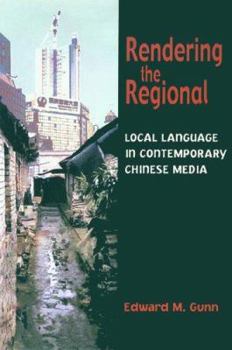
Rendering The Regional: Local Language In Contemporary Chinese Media
No Customer Reviews

For centuries the sub-national languages of China have been a fundamental feature in daily life and popular culture, while a standardized form of Mandarin has been adopted as the language of the state (including education). Suppressed during powerful movements to establish a modern, national culture, these local languages or dialects have nevertheless survived, and their resurgence in the media and literature has caused tensions to surface. Concerns for education, law, and commerce have all promoted a standard national language, yet, at the same time, as local societies have undergone massive transformations, the need to re-imagine communities has repeatedly challenged the adequacy of a single language to represent them. This ground-breaking study surveys in detail the sweep of local languages in television, radio, film, and print culture of late twentieth-century mainland China, especially Beijing, Shanghai, Chongqing and Chengdu, Hong Kong, and Taiwan. Focusing on these regions, the analysis contrasts and compares these distinct communities to each other and to the ways in which they mediate culture as a national institution. explores how varied genres and media have sought to represent the tensions and assertions within these societies and how they construct the local in an age of globalization.
Format:Hardcover
Language:English
ISBN:0824828836
ISBN13:9780824828837
Release Date:January 2005
Publisher:Univ of Hawaii Pr
Length:261 Pages
Weight:1.25 lbs.
Dimensions:9.5" x 1.0" x 6.5"
Customer Reviews
0 rating
Copyright © 2026 Thriftbooks.com
Terms of Use | Privacy Policy | Do Not Sell/Share My Personal Information | Cookie Notice | Cookie Preferences | Accessibility Statement
ThriftBooks ® and the ThriftBooks ® logo are registered trademarks of Thrift Books Global, LLC
ThriftBooks ® and the ThriftBooks ® logo are registered trademarks of Thrift Books Global, LLC
