


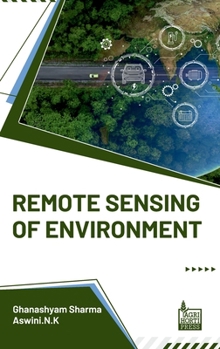
Remote Sensing of Environment
No Customer Reviews

Introduction to Remote Sensing: Provide an overview of remote sensing as the science of acquiring information about Earth's surface without direct contact, using satellite or aerial sensors. Principles of Electromagnetic Radiation: Discuss the interaction of electromagnetic radiation with Earth's surface features and how different wavelengths are used to detect various environmental elements. Sensors and Platforms: Highlight types of sensors (passive and active) and platforms (satellites, drones, aircraft), along with their roles in capturing environmental data. Image Acquisition and Processing: Explore techniques for acquiring, preprocessing, and interpreting remote sensing images, including radiometric and geometric corrections. Environmental Applications: Examine key applications such as land use/land cover mapping, forest monitoring, agriculture assessment, water resource management, and disaster response. Vegetation and Soil Monitoring: Discuss how vegetation indices (like NDVI) and thermal imaging help in assessing plant health, drought stress, and soil conditions. Climate and Atmospheric Studies: Highlight the use of remote sensing in monitoring climate change indicators, air quality, temperature variations, and weather patterns. Advances and Future Trends: Introduce emerging technologies like hyperspectral imaging, LiDAR, and AI-based analysis that enhance the precision and utility of remote sensing for environmental monitoring.
Format:Hardcover
Language:English
ISBN:9377670020
ISBN13:9789377670023
Release Date:January 2026
Publisher:Agri Horti Press
Length:202 Pages
Weight:1.02 lbs.
Dimensions:0.5" x 6.1" x 9.2"
Customer Reviews
0 rating
Copyright © 2026 Thriftbooks.com
Terms of Use | Privacy Policy | Do Not Sell/Share My Personal Information | Cookie Policy | Cookie Preferences | Accessibility Statement
ThriftBooks ® and the ThriftBooks ® logo are registered trademarks of Thrift Books Global, LLC
ThriftBooks ® and the ThriftBooks ® logo are registered trademarks of Thrift Books Global, LLC
