


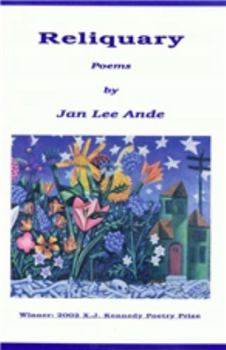
Reliquary: Poems

"From the beach near St. Michael's I pocketed a stone, planning to teach it to speak. I didn't expect it to blurt out "orca" or "metamorphic," but I knew stories were buried somewhere inside." -- Teaching a Stone, Reliquary
Format:Paperback
Language:English
ISBN:1881515559
ISBN13:9781881515555
Release Date:June 2003
Publisher:Trp: The University Press of Shsu
Length:88 Pages
Weight:0.44 lbs.
Dimensions:0.4" x 6.3" x 9.0"
Customer Reviews
4 ratings
Sharp Pleasures
Published by Thriftbooks.com User , 17 years ago
"Reliquary" offers us two distinct pleasures not often encountered in poetry today. The first is the pleasure of pure learnedness, the pleasure all poets feel, whether they admit it or not, in participating in the age-old conversation among words and books. The second pleasure offered up by the book is the rather voyeuristic one of partaking of another's spiritual yearning, in this case mediated through a close and loving observation of the natural world. Few poets today have the courage to reveal their craving for spiritual comfort so nakedly. I for one am grateful for it. Keep writing!
Antidote
Published by Thriftbooks.com User , 22 years ago
Ande writes with the close confessional voice of Sharon Olds, the ecstatic vision of Blake and the scientific pinpoint accuracy of Pattiann Rogers. Weaving through almost every poem is her quiet yet almost slap-stick sense of humor, if there is such a thing as spiritual slap-stick. Hopeful and wise, these poems are welcome in these troubled, self-absorbed times.
Reliquary, the Sacred and Surprise
Published by Thriftbooks.com User , 22 years ago
Jan Lee Ande's second full-length book of poems "Reliquary," solidly enriches what the reader encountered in the poet's first offering "Instructions for Walking on Water." Reliquary, defined as a receptacle, such as a coffer or shrine, for keeping or displaying relics is such an apt title because in "Reliquary" the poet invites the reader into a showroom where they find moments of consciousness where words push up against themselves and reveal new meaning. Words are given the sacred task to speak to worlds beyond and sometimes below. I was surprised as I engaged in the depth of the journey. If we think of books as sacred objects the poems of "Reliquary" must be thought of as sacred glimpses. Each poem opens a door. The poet provides the key. I have been involved in the medical field for twenty years so it isn't surprising that I was drawn to the poem "Learning Anatomy." Here a mother, as "study partner," is stationed next to her son and a human skeleton where they take on the task of learning the bones of the body and what each one means on many levels. What is surprising is what the poet finds in her dialogue with these bones and their articulations. The poem concludes, "After the soul has fled the body, after the organs / crumble into dust, bones pass time in the urn of the earth." This is what you'll find in reading Jan Lee Ande. Surprise! Regardless of background I'm convinced a door can open for anyone who is moved to read her. She pushes the reader beyond the ordinary and into realms where the familiar is new and fresh.
Reliquary: Relishing the Extraordinary
Published by Thriftbooks.com User , 22 years ago
Ande's Reliquary is a superbly crafted collection of poetry that cracks through surfaces and reveals the sacredness and connected nature of underlying things: the celestial mix of physical and mystical that permeates rocks, trees, hearts, thoughts and which drives science, religion, and wonder.Ande invites us:If you are lost in this world, bewilderedin the middle groundbetween heaven and earth, stand here.And so begins the delicious ascent into the incredible world of Ande's language and imagery, for the very first thing one notices, before one even considers poetic form, is the sheer beauty of the language and the freshness of the imagery. In her poetry, words exceed their representational function - they sparkle, they shoot like stars through the soul - and, as one rereads each piece, the words emerge and reemerge in a metamorphosis that, for all its metaphysical qualities, is at the same time as grounded in realism as the texture of the page upon which the images are so craftfully arranged.The title poem, "Reliquary," epitomizes the book's theme of sacredness-in-the-ordinary. Ande writes:I do not have a theca issued by the pope- the red wax seal and a length of thread - to prove these relics are authentic.My theca is the pollen sac of an anther,spore case of a greeny moss,outer layer of the pupa of the rose weevil.However, it is the intangible collection of reliquaries that gives the poem a deeper import: questions (Do you believe in nature spirits, / can oak trees talk, have you walked on water?) and embellished remembrances (My sky blue traveling case. Sarcophagus / of the holy bones of my black dog who could fly.) remind the reader that relics are more than carefully preserved items - they are magical, they house our dreams, they hold incredible secrets. Ande's gift for blending concrete and metaphysical images infuses her work. Yet, there is a fine balance between Ande's poetic gifts and the poems' forms, as well. Usually filling just one page, and usually written in couplets or triplets, the poems are easy on the eye; as a result, their framework provides just the right space for the reader to perfectly engage with the spirit of the poem.
Copyright © 2026 Thriftbooks.com
Terms of Use | Privacy Policy | Do Not Sell/Share My Personal Information | Cookie Policy | Cookie Preferences | Accessibility Statement
ThriftBooks ® and the ThriftBooks ® logo are registered trademarks of Thrift Books Global, LLC
ThriftBooks ® and the ThriftBooks ® logo are registered trademarks of Thrift Books Global, LLC
