


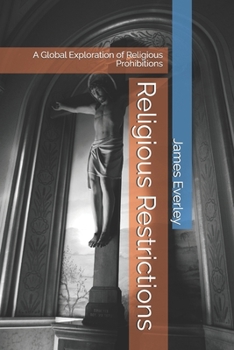
Religious Restrictions: A Global Exploration of Religious Prohibitions

This book embarks on a comprehensive global exploration into the potent and often perplexing world of religious prohibitions. It ventures beyond the familiar to uncover a vast landscape of divine decrees and sacred taboos that shape the daily lives of billions. From what can be eaten and worn to whom one can marry and how one must conduct business, these restrictions form the invisible architecture of faith communities. This exploration seeks to understand these rules not as arbitrary commands, but as the fences that guard the sacred, the bedrock of collective identity, and a pathway for the faithful to navigate the complexities of life with purpose and meaning.
Delving into the specifics of daily life, the book examines some of the most fundamental areas of restriction. It begins with the intricate dietary laws that elevate the simple act of eating into a ritual of spiritual significance, from the kosher rules of Judaism and halal guidelines in Islam to the principle of non-violence that guides Hindu and Jain vegetarianism. The journey continues to the external presentation of the body, investigating how dress codes-from the hijab and kippah to the saffron robes of a monk-become a powerful language of faith, identity, and modesty in an increasingly secular world. The sacred nature of time itself is explored through the prohibitions on labor that define the Jewish Shabbat, the Christian Sunday, and the Islamic day of assembly.
The exploration then moves into the more abstract and fiercely contested territories of belief and behavior. It tackles the volatile prohibitions on blasphemy and heresy, where the power of prohibited words has shaped history. It navigates the complex rules that govern marriage, divorce, and kinship, which are seen as essential for the preservation of faith and community. The ancient concepts of ritual purity and pollution are examined, revealing how religions engage with the basic biological realities of life, from childbirth to death. The book also provides an in-depth look at the prohibitions surrounding idolatry, tracing the profound impact of the ban on "graven images" on the artistic traditions of Judaism, Islam, and Christianity.
Finally, the book confronts the most pressing challenges where ancient faith meets modern reality. It addresses the charged ethical debates surrounding the sanctity of life, from abortion to euthanasia, and the complex relationship between faith and finance, including prohibitions on usury and obligations of tithing. It explores how timeless rules are adapting to, or clashing with, new technologies like the internet and advanced medical procedures. In a world of unprecedented global connection, this work considers the future of these ancient restrictions as they navigate the powerful currents of secular governance, human rights, and the enduring human quest for a righteous life.
Customer Reviews
ThriftBooks ® and the ThriftBooks ® logo are registered trademarks of Thrift Books Global, LLC
