


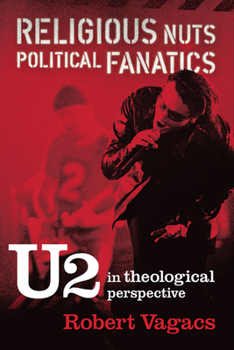
Religious Nuts, Political Fanatics: U2 in Theological Perspective

Select Format
Select Condition 
Book Overview
Weaving the threads of U2's lyrics, scripture, and theology into one cord, this book tracks the Irish rock band's theological insights and perspectives through their poetry. Along this lyrical path we encounter the characters of the Drowning Man, the Wanderer, and the Sojourner. Though seemingly different, they are one and the same, and they represent each of us. If you're a U2 fan, a theologian, or both, "Religious Nuts, Political Fanatics: U2 in Theological Perspective" will offer a different angle of popular culture and theology.
Format:Paperback
Language:English
ISBN:1597523364
ISBN13:9781597523363
Release Date:November 2005
Publisher:Cascade Books
Length:116 Pages
Weight:0.40 lbs.
Dimensions:0.3" x 7.0" x 8.8"
Customer Reviews
4 ratings
Simply perfect.
Published by Thriftbooks.com User , 18 years ago
I have read just about every book on U2. This is shorter than gems like 'One Step Closer' or 'Get Up Off Your Knees', but the best by far. The author starts with a little personal insight into his love for U2, and then uses his credible background to spin out well organized, well written chapters on various theological topics in U2. One chapter in particular, "The Babylonian State of Zooropa", was about the most philosophical insight into Bono's lyrics I'd ever read. Ever. It even inspired me to teach a lesson at my church based on "Zooropa" and "Pop" (which are the 2 most underrated albums ever, as the author even seems to recognize). I applauded how much and how wonderfully this little book executed in its perfectly short length. It was small; a quick read with very much insight and thought provocation. Buy it NOW.
Moves in mysterious ways...
Published by Thriftbooks.com User , 20 years ago
My first introduction to the 'theology' of U2 and its applicability to modern worship contexts came from the book 'Get Up Off Your Knees : Preaching the U2 Catalog' by Raewynne J. Whiteley. This book is addresses some of the same material, and is a good companion to Whiteley's book. Vagacs makes the apt point that music of U2's sort is the poetry of the modern age. Adults young and old don't tend to learn poetry, but they do remember song lyrics, and many of these song lyrics contain deep, meaningful, spiritual content. Vagacs taps into the categories of biblical interpretation and meaning-making of Walter Brueggemann (one of my personal favourites), and looks to the medium of modern rock and roll ('potent poetry' that 'allows the artist to express raw emotion and high intellect simultaneously') to be a means toward an 'alternative universe of discourse'. It isn't simply in the lyrics of U2 songs that the call to fulfilling a moral purpose, a gospel statement if you will, comes into being. Bono has taken upon himself the task of educating and drawing the media spotlights to issues of world poverty, hunger, and financial mismanagement that is a somewhat ironic stance for a 'pop star'. However, no one else seemed to be stepping up to the plate. Bono was honoured with the Bill and Melinda Gates by Time magazine, not for fame and fortune, but rather for turning fame and fortune into a force for good in a specific, savvy and increasingly effective way. There are elements in U2 songs that all Christians can find familiar - hope and despair, faith and doubt, longing and desire, dealing with injustice and finally finding grace. All of these things, from lamentations to psalms and proverbs, have parallels in both biblical and U2 lyrical words. Vagacs deals with the idea of the postmodern (an idea he admits is difficult to define, particularly in so short a work), and demonstrates in many ways that U2 is a postmodern embodiment of many biblical themes. Vagacs includes a litany inspired by U2 lyrics, merged with themes and words from the gospel of Mark. Vagacs also includes a discography, source lists, and a recommended readings list. These are handy things for those who might want to further their study, or incorporate U2 into actual worship services. Vagacs includes a glossary of terms at the start, rather than at the end. This is both for U2 fans who are not theologically/philosophically trained, as well as for those theological types who don't have a wide exposure to modern popular/rock music. Vagacs states, 'My hope is that this book will be of interest to U2 fans, offering them perhaps another perspective on U2's lyrics. I would also hope that those who are Christian, or religious, would recognize that the marriage of theology, faith and popular culture is not only possible, but relevant and fruitful as well.'
Simply Brilliant...
Published by Thriftbooks.com User , 20 years ago
Vagacs covers U2 from their early days of "Boy" to their most recent release, "How To Dismantle An Atomic Bomb", and dismantles the meaning behind U2's lyrics in a way I have NEVER read about before. He does it so brilliantly... read on below. Vagacs easily intertwines the meaning of finding one's self in this world from the idea of orientation, disorientation, and finally reorientation. From U2's first release, "Boy", in 1979, they sing about faith, God, growing up, and spirituality. After this came "October" which has the most easily recognizable songs of praises to God, and one would almost think U2 was on a Christian record label. Later came "War" with the famous "Sunday Bloody Sunday" in which Bono sings, "To claim the victory, Jesus won." With these early releases, U2 knows their orientation in this world belongs with their faith in God. However later then comes "The Joshua Tree" in the mid-eighties in which they start to question things around them and further seek to orientate one's selves into society and where God and everyday social, political, and everyday life meets. It's a journey where "The Streets Have No Name", and where "I Still Haven't Found What I'm Looking For". Thus soon came that moment when some criticizing "religious nuts" misunderstood U2's creative side for thinking they lost their faith. It was a time during three very different U2 releases within a short period of time between 1991 to 1997. We had it all from the great ground-breaking "Achtung Baby" to "Zooropa", and lastly to "Pop". This was the representation of what we call disorientation in life. The sex, the drugs, and the rock and roll... yet somehow if you REALLY listen to the music and get past all the hype of Bono dressing as the devil, Mr. Macphisto, and etc... during Zoo TV, Pop Mart--- the lyrics are VERY honest in seeking God amongst all the evils and temptations of our world. Also hasn't anyone ever stopped and realized that Mr. Macphisto is Mephistopheles from Johann Wolfgang von Goethe's book entitled "Faust" about a man who sells his soul to the devil for all the riches in the world. Furthermore, Bono at that time of U2's career had read "The Screwtape Letters" by the Christian writer C.S. Lewis. I also suggest reading in the bible, James 4:7, "Resist (mock) the devil and he shall flee from you." Bono was mocking the devil, not trying to be the devil. "Pop" ended with a great song "Wake Up Dead Man" in which Bono longs for Jesus to wake up in this world and do something... it's a Psalm of lamentation in a well-written form. On "Achtung Baby"-- we get to wonder if Judas will ever be redeemed by Jesus and receive eternal life-- really listen to the words of "Until The End of The World". The best line of the song is "With waves of regret and waves of joy, I reached out for the one I tried to destroy..."-- was Judas in waves of regret praying Jesus would forgive him for kissing his cheek and giving him to the cross for his crucifixion; and yet in waves
Bono and Jesus
Published by Thriftbooks.com User , 20 years ago
Vagacs does many unique and intriguing things in this little volume. He examines the collective works of U2 through the theological lenses of Walter Brueggemann to interpret their albums and specific songs. The categories he borrows from Brueggemann are the themes of hope amidst despair, social justice and eschatological anticipation, exile in a scorched land, and finally grace and resurrection. Vagacs was drawn to undertake this endeavor after attending a U2 concert, which raised a number of questions in his mind. He states: "They prompt me to ask what is it exactly about U2's music that captivates people from such a diverse demographic, not to mention geographic, diversity? Is it their consistency, or their cohesiveness as a band? Is it their commitment to the music and each other? Is it U2's concern and involvement with social justice issues? Perhaps it is simply the fact that they generate great music?" (p.ix) Vagacs believes that there are 4 categories of readers for this book: 1. You are neither a U2 fan nor a Christ follower. 2. You are a U2 fan with no real connection to Jesus Christ. 3. You are a Christian with no real connection to U2. 4. You are both a U2 fan and a Christ follower. No matter which category you are in, this book can be informative, both on the history of U2 and the progression of thought through their music, and the spiritual imagery and implications of their work album by album. No matter which of the four you are, this book will open your eyes. Brian Walsh in the introduction states: "Rob Vagacs does not come to worship at the shrine of U2. That would be a blasphemy to his own faith and a terrible disservice to the band. Rather, this book opens our eyes to light that is shining in the midst of the darkness of a postmodern world." (p.xvi) I believe it sums up the book well. This book will not herald U2 as the light, but as light bearers in a darkening world. This book will help you see light around you, whether in other people, music, or even theology.
Copyright © 2026 Thriftbooks.com Terms of Use
| Privacy Policy | Do Not
Sell/Share My Personal Information | Cookie Policy | Cookie Preferences | Accessibility Statement
ThriftBooks® and the ThriftBooks® logo are registered trademarks of Thrift Books Global, LLC
ThriftBooks® and the ThriftBooks® logo are registered trademarks of Thrift Books Global, LLC
