


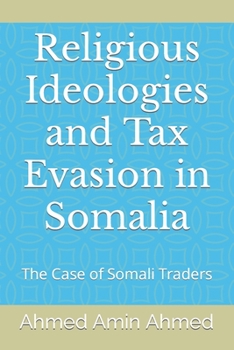
Religious Ideologies and Tax Evasion in Somalia: The Case of Somali Traders
No Customer Reviews

Tax evasion is a major concern facing not only the delicate Somali economy but also the global one. Since the collapse of the central government in 1991, before which most services and the industrial sector were government-run, Somalia has seen substantial investment in commercial activities such as money transfer services, telecommunication, and trade, and-so-on. The FGS (Federal Government of Somalia) - in place since 2012 when it replaced the TFG (Transitional Federal Government) - has a crisis on its hands and risks plunging the nascent state back into civil strife unless it extricates itself from its dependence on the minimal foreign donations that are too insufficient to meet an expanding public expenditure. While there may be other solutions to this endemic problem, the most viable is, undoubtedly, taxation. Taxes are crucial to governments and, without them, they would be unable to function properly. Some of the key sources of government revenue for development activities in developing countries are income and sales taxes. In Somalia, however, big businesspersons and traders are unwilling to pay these taxes to the Federal Government of Somalia. The reluctance of these rich and wealthy traders who live in the capital to pay taxes were investigated to determine the causes of their unwillingness to contribute to the government revenue. Accordingly, this study examined the influences of ideology and cultural traditions on tax evasion. The data collection instrument in this study was a structured questionnaire, which consisted of a 5-item Likert Scale that was divided into three parts: demographic data, religiosity scale, and tax justification statements. The objective of the study was to highlight the relationship between the religious ideologies of Somali traders and the growing problem of widespread tax evasion in Somalia. The Slovin's formula with a margin of error e of 5% was used to calculate the sample size n. This research was authorized by the Research Department of Accord University in fulfilment of the requirements for Master in Accounting and Finance.
Format:Paperback
Language:English
ISBN:B0BB5MX4RT
ISBN13:9798847371087
Release Date:August 2022
Publisher:Independently Published
Length:78 Pages
Weight:0.26 lbs.
Dimensions:0.2" x 6.0" x 9.0"
Customer Reviews
0 rating
Copyright © 2026 Thriftbooks.com Terms of Use
| Privacy Policy | Do Not
Sell/Share My Personal Information | Cookie Policy | Cookie Preferences | Accessibility Statement
ThriftBooks® and the ThriftBooks® logo are registered trademarks of Thrift Books Global, LLC
ThriftBooks® and the ThriftBooks® logo are registered trademarks of Thrift Books Global, LLC
