


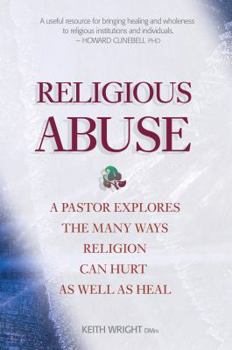
Religious Abuse: A Pastor Explores the Many Ways Religion Can Hurt as Well as Heal

As a pastor with 40 years of experience, Keith Wright came to realize that a dichotomy exists within the walls of many churches. While many churchgoers find the environment wonderfully embracing and... This description may be from another edition of this product.
Format:Paperback
Language:English
ISBN:189683647X
ISBN13:9781896836478
Release Date:January 2001
Publisher:Northstone Publishing
Length:192 Pages
Weight:0.58 lbs.
Dimensions:0.6" x 6.3" x 9.0"
Customer Reviews
5 ratings
Healing Hurt by Rligious Insight
Published by Thriftbooks.com User , 24 years ago
Having experienced both childhood and clergy religious abuse, I rejoiced to discover Dr. Wright's book. It helped me understand the sources of my own pain and ways to overcome it. This work identifies many kinds of abuse in religious communities, and examines correctives to discourage, prevent and heal such abuse. Wright draws on 45 years of pastoral experience, the work of other authors, takes resources from psychology, current Biblical scholars and theologians. There are personal stories of both pain and healing from his own experience and that of others. Dr. Wright describes several forms of abuse and uses Scriptural references to propose appropriate behaviors. In Chapter 5, "Religion and Abuse of Women," Wright cites an account of a mother trying to discuss the Image of God with her young children, and is astonished by her daughter's response. The daughter announced that she isn't like God because she is a girl, but her brother is like God because God is a boy. (p. 86ff) This erroneous position certainly learned in church, was carried historically in both Jewish and Christian practice, causing a patriarchal demeaning of women. Wright offers an interpretation of Genesis 1-3 which separates the creation of humankind, both male and female, in God's image from the post-fall prescriptive against Eve to be subwervient to her husband. In the chapter "Religion and the Abuse of Clergy," one abuse is forcing the pastor to be untruthful about what he/she has learned in seminary. This is caused by denominational leadership and executives, and congregational reluctance to listen to new ideas. Wright does discuss the abuse of pastors caught between parties to conflict. In my experience and observation, the use of power in church conflict is more harmful and painful, including the "collateral damage" to family and friends, than any other form of clergy abuse. Appropriate uses and misuses of power are dealt with in the chapter "Theologial Sources of Abuse." This chapter deals with the power of God, in Paul's phrase, as the power of weakness. In the final chapters, Dr. Wright proposes a reinterpretation of the life, work, death and resurrection of Jesus as a compaassionate calling back of strayed persons, rather than the exaction of a price for disobedience of God. He denies the traditional explanation of the transmission of sin as genetic and inherited. This will certainly dismay some readers, but I found it reassuring and contributing to an understanding of God's sompassionate love and the love and compassion we can share with each other--a true cure for religious abuse!
healthy religions abolish abuses
Published by Thriftbooks.com User , 24 years ago
This is an important book for leaders and members of every religious tradition.Keith Wright offers examples of abusive behavior which in the past have been tolerated or ignored, and he urges that the issue of abuse be recognized and challenged despite the possible costs of speaking up.The treatment of clery by congregations and administrators has been called a "cruelty system." This is common knowledge among ministers and administrators, but few, like Keith Wright, have had the courage to name these behaviors "religious abuse." Wright reminds his readers that "everybody knows that the church has been guilty of much evil, but very few people within the church are willing to tell the truth."Ministers and lay people have quietly left their congregations in response to the pain they have suffered in the name of religion. Wright covers a wide range of types of abuse in this thought-provoking book, including the abuse of workaholic preachers who burden people with more than they can handle, and the withholding of approval from a significant person in your life.I believe that this book should be read widely in the church and especially by clergy, lay leadlers and seminarians. Its strength is that it is written by an ordained minister who loves the church and who continues to value the experience which a life lived connected to a religious tradition provides. Its challenge is to see and label abuse when it occurs and then to act to stop the abuse.Wright concludes: "Our task is to recognize and discourage religious abuse where it occurs while doing our best to foster and nurture those aspects of religion which are life-giving and life-sustaining."
Let's Recognize Religion Can Both Heal and Hurt
Published by Thriftbooks.com User , 24 years ago
Keith Wright's four decades of personal experiences as a pastor in a mainline Christian denomination provide the bricks for this book, his ruminations and researches, the mortar. Dr. Wright uses his firsthand knowledge of people who have been pricked, punched, or crushed by religion to declare that, "I am very much aware of the blessings of religion; and I am very much aware of its abusive side. I have felt it necessary to call attention to that abuse because it is there and because we who are part of the church must admit it." (page 169). He speaks not as someone who wishes to rail against religion, but as a committed Christian leader who thinks it imperative to recognize that religion itself has and will continue to abuse people, but through introspection and honesty some of the abusive practices can be lessened. As we, individually, are created good, make mistakes and acknowledge our shortcomings, and need redemption and restoration to wholeness, so the church, corporately, is created good, has made mistakes and needs to acknowledge its shortcomings, and needs redemption and restoration to wholeness.At the start of the book Dr. Wright uses a number of firsthand cases illustrating lives hurt by religion, starting with his own parents. Dr. Wright classifies these abuses into categories, such as the religious abuse of women, of children, of overworking church members, of clergy. I couldn't help but think, "What would I tell this person?" These cases are a gold mine for discussion in a church study or home study group. As Dr. Wright discusses the personal stories, he talks at length about how he would or could have responded, using the Bible, outside research, and his own synthesis. In this aspect Dr. Wright's book reminds me of the format used by Harold Kushner in When Bad Things Happen to Good People. Dr. Wright makes the case that much of the abuse can ultimately be traced to a religion's emphasis on doctrine and judgment rather than personal growth and love. I found the longest chapter, the one titled The Abuse of Clergy, to be particularly fascinating. Dr. Wright uses more personal examples here than any other chapter. The stories are poignant: overworked clergy trying to keep factions from dividing the church, seminary students fudging their personal "belief statements" to fit the status quo, churchmembers out to bring the pastor down, and pastors writing safe and innocuous sermons feeling they cannot challenge their congregations. No doubt pastors circulate similar stories among themselves but it is healthy for us in the congregation to see what abuses our leaders can and do suffer at times.Although I really like the book, one criticism I have is that there are not enough of his firsthand stories of religious abuse to think about. Dr. Wright loads the first and last chapters with his personal experiences (I counted 24 firsthand stories in the entire book), but the middle chapters had few or even none, though Dr. Wright uses
Abuse & Understanding
Published by Thriftbooks.com User , 24 years ago
This book, Religious Abuse, addresses a subject which is far too often swept under the rug and kept out of sight. Rev. Wright looks at the subject in all it's negativity but he then notes the positive. What makes this book remarkable is the fact he does not leave one with a feeling of hopelessness when he is through. This is a "must read" book for all age groups and will enhance everyone's understanding/comprehension of what at first glance seem to be mystery/incomprehension.
Many Heads Nodding
Published by Thriftbooks.com User , 24 years ago
I was raised in a family where church was an integral part of the week - Sunday School, choirs, Bible School, etc. When I left home, I started traveling around the world and seeing other religious faiths at work. Some of their practices were very interesting to me, some were scary, at best. It made me take a look at my own Christian religion - if all these faiths believed they were the one and only true faith, how could mine be that as well? It was also then I realized how many awful things in our current world situation are caused in the name of religion and God - Northern Ireland and England, Palestine and Israel, Bosnia and Herzogovinia, and now the Muslim/Christian battle we are facing on our own shores. This book addresses these same issues, but also those close to home - children and spouses who are beaten or punished in the name of religion; churches that expect congregations to give more in time and money than many are able; churches whose message to the congregation is one of hell-fire and damnation, rather than one of the love and peace so often missing in our world. Dr. Wright addresses each of these issues and I think readers will find themselves nodding their heads in agreement throughout the book.This is a very powerful tool for people in position to do something to change these very problems caused in the name of religion.
Copyright © 2026 Thriftbooks.com
Terms of Use | Privacy Policy | Do Not Sell/Share My Personal Information | Cookie Policy | Cookie Preferences | Accessibility Statement
ThriftBooks ® and the ThriftBooks ® logo are registered trademarks of Thrift Books Global, LLC
ThriftBooks ® and the ThriftBooks ® logo are registered trademarks of Thrift Books Global, LLC
