


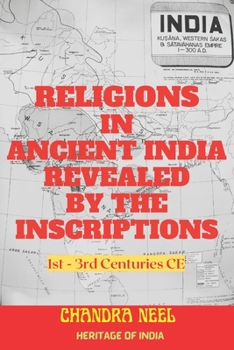
Religions in Ancient India Revealed by the Inscriptions: 1st - 3rd Centuries CE
No Customer Reviews

It is an established fact that the 'Religious Faith' is the core of any social setup around which it acquires its form, undergoes changes and develops accordingly. This is the reason that most of the inscriptions of Ancient India during the period under review are chiefly associated with some or the other religious faith of the time, incorporating other aspects of the society as well, like the political, administrative, economic, etc. merely as the subordinate elements. The period under concern, i.e. between the 1st and 3rd centuries CE is a witness to lots of ups and downs not only on the political front, but also in the arena of religious beliefs and practices - partly due to the foreign invasions and the resulting new interactions, and partly due to the perturbing circumstances that developed within its own periphery. When we try to trace the reasons of religious inconsistency in Ancient India during the period under consideration, we learn that by the 6th century BCE, the social and religious bewilderment grew so much that there developed a situation of turbulence everywhere. This book unveils the major reasons associated with the setback of the existing Vedic rituals and practices and the strong emergence of Jainism and Buddhism in the confusing socio-religious scenario during the period under concern. It further unfolds how the policy of 'Religious Tolerance' played a major role in maintaining a complete religious harmony during this period even under the situation of tremendous political commotion, interactions of different cultures due to foreign invasions and the resulting assimilations.
Format:Paperback
Language:English
ISBN:B0BW31X28S
ISBN13:9798378785872
Release Date:February 2023
Publisher:Independently Published
Length:78 Pages
Weight:0.28 lbs.
Dimensions:0.2" x 6.0" x 9.0"
Customer Reviews
0 rating
Copyright © 2026 Thriftbooks.com Terms of Use
| Privacy Policy | Do Not
Sell/Share My Personal Information | Cookie Policy | Cookie Preferences | Accessibility Statement
ThriftBooks® and the ThriftBooks® logo are registered trademarks of Thrift Books Global, LLC
ThriftBooks® and the ThriftBooks® logo are registered trademarks of Thrift Books Global, LLC
