


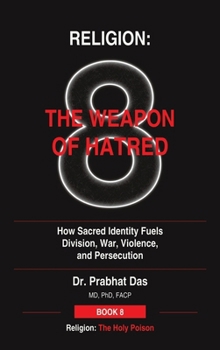
Religion: The Weapon of Hatred: How Sacred Identity Fuels Division, War, Violence, and Persecution

No child is born hating a neighbor's God. So who puts an enemy in a child's heart?
Before the slogans, the sacred boundaries, and the first stone thrown, there is a story: We are righteous. They are dangerous. God is on our side. What happens when people believe that story so completely that cruelty begins to feel like duty?
In Religion: The Weapon of Hatred, subtitled How Sacred Identity Fuels Division, War, Violence, and Persecution, Dr. Prabhat Das, MD, PhD, FACP, examines how faith becomes a dividing line-and how that line can run through neighborhoods, nations, families, and the human conscience.
Book 8 of the Religion: The Holy Poison series confronts an unsettling possibility: people do not always commit terrible acts because they have abandoned their moral convictions. Sometimes, they commit them because they believe those convictions demand it.
How does a neighbor become an infidel? How does a question become blasphemy? How does killing become holy?
Drawing on history, psychology, and his perspective as a physician, Dr. Das follows the transformation from belonging to exclusion, from grievance to collective guilt, and from fear to persecution. He asks what religion adds to conflicts driven by power, territory, nationalism, and resentment-and what changes when human hostility claims divine approval.
Inside, discover:
- How "us" and "them" take root: the stories and labels that teach people whose lives deserve compassion-and whose suffering can be ignored.
- Why old hatreds survive: patterns of persecution, antisemitism, communal violence, and sectarian conflict that outlive the people who first spread them.
- What happens when religion defines a nation: how neighbors become outsiders in the country they call home.
- How children inherit enemies: the everyday lessons that pass suspicion and resentment from one generation to the next.
- Why millions pay for one person's crime: the logic of collective blame and the cycle of revenge it sustains.
- How hatred travels at digital speed: the meeting of religious authority, political ambition, propaganda, and social media.
This book asks you to look beyond distant battlefields. Consider the rumor forwarded without checking. The prejudice excused as tradition. The victim whose pain seems less urgent because of a different name or faith. These small permissions matter. They shape what a society will tolerate when fear takes hold.
You can respect people without surrendering your right to question beliefs.
That principle gives this challenging book its humane center. Dr. Das rejects inherited guilt and invites readers to judge individuals by their actions. His concern is the human being beneath the religious label: the frightened child, the grieving parent, the neighbor whose life is as precious as our own.
Whether you are a believer wrestling with questions, a skeptic seeking a deeper understanding, or a reader troubled by religious division, this book offers a way to examine the forces that turn identity into hostility. An appendix addresses common religious claims and objections, with further reading to continue your exploration.
We teach children who they are. Must we also teach them whom to hate? Open this book-and reconsider the enemies we inherit.
Customer Reviews
ThriftBooks ® and the ThriftBooks ® logo are registered trademarks of Thrift Books Global, LLC
