


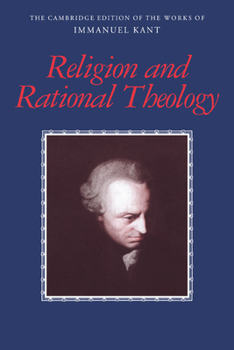
Religion and Rational Theology

Select Format
Select Condition 
Book Overview
This volume collects for the first time in a single volume all of Kant's writings on religion and rational theology. These works were written during a period of conflict between Kant and the Prussian authorities over his religious teachings. His final statement of religion was made after the death of King Frederick William II in 1797. The historical context and progression of this conflict are charted in the general introduction to the volume and in the translators' introductions to particular texts. All the translations are new with the exception of The Conflict of the Faculties, where the translation has been revised and re-edited to conform to the guidelines of the Cambridge Edition. As is standard with all the volumes in this edition, there are copious linguistic and explanatory notes, and a glossary of key terms.
Format:Paperback
Language:English
ISBN:0521799988
ISBN13:9780521799980
Release Date:March 2001
Publisher:Cambridge University Press
Length:548 Pages
Weight:0.05 lbs.
Dimensions:1.1" x 6.1" x 9.2"
Customer Reviews
1 rating
Imprescindible
Published by Thriftbooks.com User , 20 years ago
Every serious scholar in Kant or Theology must owe this superb volume. It contains many unknown and important works in order to achieve a complete and accurate vision of Kant's moral theory and his philosophy of religion, as well as his whole system of philosophy, developed throughout the three Critiques. Kant himself delimited his philosophical project in the formulations of these three questions: "What can I know" --What I ought to do? and -What am I to expect? (CPR A 804/ B 832). Kant told that the last question, the theological one, was to be answer in "The religion within the limits of mere reason" of 1793 (AK 11: 414), a monumental work that makes clear several issues being somehow murky for the readers of the Groundwork and the Critique of the Pure reason, such as the value of the faith, the intelligible grounds of free will and the relation between morals and traditional religion.
Copyright © 2026 Thriftbooks.com
Terms of Use | Privacy Policy | Do Not Sell/Share My Personal Information | Cookie Policy | Cookie Preferences | Accessibility Statement
ThriftBooks ® and the ThriftBooks ® logo are registered trademarks of Thrift Books Global, LLC
ThriftBooks ® and the ThriftBooks ® logo are registered trademarks of Thrift Books Global, LLC
