


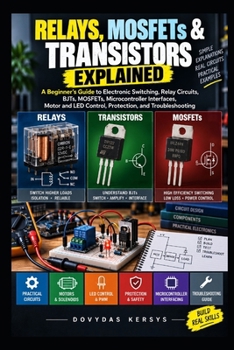
Relays, MOSFETs & Transistors Explained: A Practical Beginner's Guide to Electronic Switching, BJTs, MOSFETs, Relay Circuits, Load Control, Protection

A microcontroller pin can make a decision-but it usually cannot power the motor, solenoid, lamp, relay, or other load you actually want to control.
That is where relays, transistors, and MOSFETs come in.
Relays, MOSFETs & Transistors Explained is a practical beginner's guide to understanding electronic switching, choosing the right switching device, driving real loads safely, protecting circuits, and troubleshooting problems when things do not behave as expected.
Instead of treating relays, BJTs, and MOSFETs as mysterious components, this book explains what they actually do, how they differ, where each one makes sense, and what commonly causes switching circuits to fail.
You'll learn to think in terms of control signals, current paths, loads, switching devices, protection, voltage drop, power loss, and real measurements rather than simply copying circuits from the internet.
Inside, you'll learn:
- Why electronic switching is needed
- The difference between the control side and load side of a circuit
- How voltage, current, resistance, and power affect switching devices
- How resistive, inductive, capacitive, and motor loads behave differently
- How logic levels and reference grounds work
- Source current, sink current, and current paths
- Low-side and high-side switching
- Normally-on, normally-off, and fail-safe design thinking
- How to read switching-device datasheets
Learn:
- How relay coils, armatures, and contacts work
- Normally open, normally closed, and changeover contacts
- Relay coil voltage, resistance, and current
- How to understand contact ratings
- Why DC loads can be difficult on relay contacts
- Why flyback protection matters
- How BJTs and MOSFETs can drive relay coils
- Relay chatter, dropout, and weak pull-in
- Latching relays
- Reed and signal relays
- Solid-state relays and their limitations
Learn:
- What a bipolar transistor actually does
- NPN vs. PNP transistors
- The base-emitter junction
- How to calculate base resistance
- Saturation and forced beta
- Collector-emitter voltage and power loss
- NPN low-side switching
- PNP high-side switching
- Emitter followers and buffering
- Darlington transistors
- Basic amplifier concepts useful to switch designers
- Temperature effects and thermal runaway
- How to test and troubleshoot BJTs
Learn:
- Gate, drain, source, and the body diode
- N-channel vs. P-channel MOSFETs
- Why gate voltage must be considered relative to the source
- The common VGS(th) misunderstanding
- What "logic-level MOSFET" actually means
- RDS(on) and conduction losses
- Gate charge and switching speed
- Gate resistors, pulldowns, and pullups
- N-channel low-side switching
- P-channel high-side switching
- N-channel high-side switching and gate drivers
- MOSFET body-diode behavior
- Switching inductive loads
- PWM control of motors and LEDs
- Thermal design and safe operating area
The book also explains:
- How to choose between a relay, BJT, and MOSFET
- Why microcontroller pins should be treated as signals rather than power supplies
- 3.3 V and 5 V interfacing
- Optocouplers and electrical isolation
- Snubbers, TVS diodes, and clamp networks
- Fuses and current limiting
- Wiring protection
- Grounding and layout for switching circuits
- Design margin and derating
Customer Reviews
ThriftBooks ® and the ThriftBooks ® logo are registered trademarks of Thrift Books Global, LLC
