


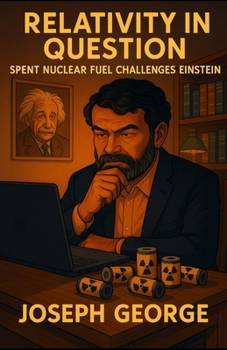
Relativity in Question: Spent Nuclear Fuel Challenges Einstein

Relativity in Question takes aim at one of the oldest blind spots in modern physics: what actually happens to the mass defect during nuclear reactions? While Einstein's iconic E = mc provides a numerical equivalence, it never identified a physical mechanism. In the microstructures of spent nuclear fuel, Joseph George argues, that missing mechanism finally reveals itself.
Drawing on decades of independent research, this book presents the Exploding Mass Defect Hypothesis (EMDH)-the proposal that the vanished mass in fission is not abstractly "converted into energy" but undergoes a rapid, localized transformation into a space-filling medium (SFM). The resulting micro-explosion provides the mechanical impulse that standard nuclear theory cannot explain, and leaves behind forensic evidence in irradiated materials: radial microcracking, shock-generated amorphous zones, and damage signatures that contradict conventional collision-cascade models.
From this nuclear-scale mechanism emerges a radical, unified physical framework. If SFM fills space and exhibits density gradients shaped by astrophysical processes, then long-standing pillars of Special and General Relativity-from time dilation to gravitational lensing-may be reinterpreted as interactions with a physical medium rather than geometric distortions of spacetime. Light bends by refraction, not curvature. Clocks slow because of medium-density effects, not gravity wells. Even dark matter and dark energy find new explanations in continuous SFM production across the cosmos.
This book is not speculative philosophy; it is a call for empirical testing. George outlines clear, falsifiable predictions: terahertz acoustic signatures of micro-explosions, pressure-dependent fragment ranges, chromatic gravitational lensing, medium-induced orbital anomalies, and altitude-dependent divergence between nuclear and electronic clocks. Any one of these results would challenge Einstein's geometric paradigm at its foundation.
Relativity in Question is written for physicists, researchers, and scientifically curious readers who recognize that even the most successful theories must ultimately submit to physical evidence. It invites the scientific community to re-examine the assumptions underlying relativity-and to follow the data back to the smallest, most explosive clues hidden inside the atom.
Customer Reviews
ThriftBooks® and the ThriftBooks® logo are registered trademarks of Thrift Books Global, LLC
