


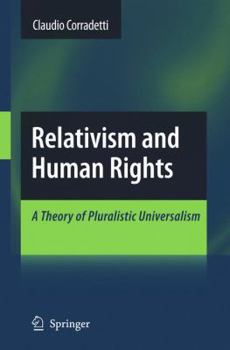
Relativism and Human Rights: A Theory of Pluralistic Universalism

Select Format
Select Condition 
Book Overview
The First Chapter discusses the possibility of constructing a notion of linguistic and moral partial commensurability while admitting, contra Davidson, the relevance of conceptual schemes. This has guided me into the investigation of schemes and commensurability in an innovative way. I have made use of the most recent results coming from cognitive linguistics and the debate upon cognitive linguistic relativism in order to overcome the idea of radical relativism.
The second chapter is a transitionary chapter and it aims at critically discussing three contemporary normative models in political philosophy. If the first part criticises the relativism of Harman, the second reject the notion of a 'view from nowhere' as developed by Nagel. It follows a criticism of Rawls' notion of primary goods and a suggestion of how some of his difficulties can be overcome through a notion of 'fundamental human rights'. This will then be developed along the third chapter.
The third chapter, develops a model of purposive agency by integrating the procedural Habermasian theory of discursive action with a revised approach to Gewirth's theory. A specific consideration is then devoted to the theoretical status of human rights judgements. In particular, there is a reference to Kant's Third Critique and a translation, into the political philosophical domain of the Kantian properties for aesthetic judgments. Several elements are derived for the understanding of the theoretical status of human rights judgments, so that from a combination of a priori principles and a posteriori synthetic judgments there obtain a rehabilitation of the notion of contingency within moral judgements. The third paragraph provides an ideal classification of the relation between law and morality. It analyses the central tenets of Aristotle, Hart, Fuller, Finnis etc. introducing my position of 'positivist inclusivism' which will be fully developed in the fourth paragraph.
Fromthe reinterpretation of the strict interlink between liberty and participatory rights, it is developed a new understanding of the functional role and of the normative validity of deliberative democracy. This paves the ground for proposing an institutional model of democracy by keeping into account the impact that different types of elections have on political representation. It follows an extension of the model of self-interested solidarity to the post-national integration of Europe though a commitment to human rights.
Customer Reviews
ThriftBooks® and the ThriftBooks® logo are registered trademarks of Thrift Books Global, LLC
