


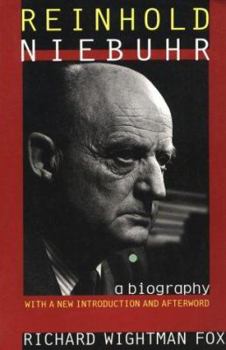
Reinhold Niebuhr: A Biography


Select Format
Select Condition 
Book Overview
First published in 1985, this widely praised biography of Reinhold Niebuhr, perhaps the most important American theologian of the twentieth century, is once again in print. "By drawing for the first time on the vast correspondence between Niebuhr and his secular colleagues, Mr. Fox demonstrates that no American theologian ever had such an impact on unbelievers. And no one has since. . . . [Fox] paints a lively picture of the beloved teacher [and] frenetic political organizer . . . Niebuhr seems to have been."--Harvey Cox, The New York Times "Based on meticulous research which includes numerous interviews and a declassified FBI file, the book is written with a verve, grace, and depth of understanding worthy of its subject. Fox is remarkably successful in fusing criticism with sympathetic appreciation and in relating Niebuhr's evolving thought to his public career and private self-scrutiny."--David Brion Davis, The New York Review of Books Fox's book is bound to establish itself as an indispensable contribution not just to our understanding of Niebuhr but to an understanding of the history of twentieth-century liberalism, which Niebuhr did so much to redefine."--Christopher Lasch, In These Times
Format:Paperback
Language:English
ISBN:0801483697
ISBN13:9780801483691
Release Date:January 1996
Publisher:Cornell University Press
Length:370 Pages
Weight:1.30 lbs.
Dimensions:9.5" x 1.0" x 6.3"
Customer Reviews
1 rating
The Vital Centrist
Published by Thriftbooks.com User , 24 years ago
Reinhold Niebuhr (1892-1971) was--and probably still is--America's most famous theologian. From the 1920s to the 1960s, hw wrote numerous books on religious and political issues, as well as articles for LOOK, THE ATLANTIC, and THE NEW REPUBLIC among many other magazines. One of his lesser known works ("God grant me the strength to change the things I can, the serenity to accept the things I cannot and the wisdom to know the difference") still adorns the bric-a-brac sold in Christian bookstores. And, not far from his old office at Union Theological Seminary in New York City, a street is named after him. Richard Wightman Fox argues that beginning in the 1930s, Niebuhr became disenchanted with the "social gospel" theology that had come to dominate the so-called "mainline" Protestant churches. Niebuhr concluded that man is an inherently imperfect creature (and therefore all attempts to create a perfect society are futile), but that Christians still have to try to Christianize the social order. Such efforts are doomed to fail if their ultimate goal is the perfectability of man, but they can succeed if they have more limited goals. In other words, the world could be made better but it could not be re-made. In this way, Niebuhr reconciled in his own mind two opposing groups: the social gospel liberals and the conservative theologians who believed in sin. Niebuhr's belief in the reality of sin combined with his quest for social justice is generally called "neo-orthodoxy," though Fox uses this term only a few times. Fox does an excellent job of demonstrating how well Niebuhr's ideas fit with the assumptions of American liberals from the 1940s through the 1960s. Cold War liberals prided themselves on being both idealistic and realistic. To borrow one of Niebuhr's own phrases, American liberals were the optimistic "children of light" when it came to wiping out poverty and racial discrimination at home, but they were the pessimistic "children of darkness" when they dealt with Soviet Communism. No wonder Reinhold Niebuhr was the intelligentsia's favorite theologian. If Fox fails to capture anything about Niebuhr, it is just how un-spiritual (non-religious?)so much of Niebuhr's writings now seem. Niebuhr focused on four topics: God, Sin, Man, and the Social Order. But somehow Sin, Man, and the Social Order frequently crowd God out of the picture, and we're left wondering if we're dealing with a theologian or a social theorist or the Democratic Party's leading intellectual. To put it only slightly unfairly, Niebuhr was a brilliant and profound theologian, but he was the kind of theologian who maybe spent too much time wondering about who the next President ought to be.
Copyright © 2026 Thriftbooks.com Terms of Use
| Privacy Policy | Do Not
Sell/Share My Personal Information | Cookie Policy | Cookie Preferences | Accessibility Statement
ThriftBooks® and the ThriftBooks® logo are registered trademarks of Thrift Books Global, LLC
ThriftBooks® and the ThriftBooks® logo are registered trademarks of Thrift Books Global, LLC
