


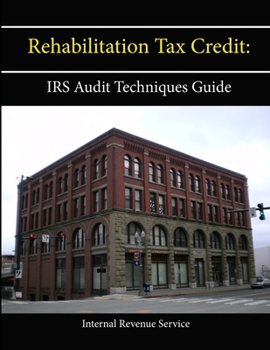
Rehabilitation Tax Credit: IRS Audit Techniques Guide
No Customer Reviews

Prior to 1976, there existed no tax incentive to rehabilitate or preserve historic buildings. The Tax Reform Act of 1976 added IRC section 191 which permitted taxpayers to amortize over a 60-month period certain expenditures to rehabilitate property listed in the National Register of Historic Places or property located in Registered Historic Districts and certified as significant to the district. The 60-month amortization period was enhanced to a 10 percent rehabilitation tax credit in 1978. In 1981, Congress expanded the rehabilitation tax credit to a three-tier credit; a 25 percent credit for "historic rehabilitations," a non-historic rehabilitation credit of 20 percent for buildings at least 40 years old, and a 15 percent credit for buildings at least 30 years old. The rehabilitation tax credit survived the Tax Reform Act of 1986, but imposed several constraints that made the rehabilitation tax credit less attractive to individual real estate investors.
Format:Paperback
Language:English
ISBN:1304114686
ISBN13:9781304114686
Release Date:June 2013
Publisher:Lulu.com
Length:188 Pages
Weight:0.99 lbs.
Dimensions:0.4" x 8.5" x 11.0"
Customer Reviews
0 rating
Copyright © 2026 Thriftbooks.com
Terms of Use | Privacy Policy | Do Not Sell/Share My Personal Information | Cookie Policy | Cookie Preferences | Accessibility Statement
ThriftBooks ® and the ThriftBooks ® logo are registered trademarks of Thrift Books Global, LLC
ThriftBooks ® and the ThriftBooks ® logo are registered trademarks of Thrift Books Global, LLC
