


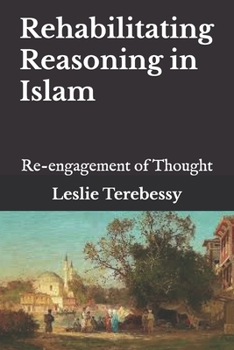
Rehabilitating Reasoning in Islam: Re-engagement of Thought
No Customer Reviews

Acquiring knowledge requires the use of reason. Reason is a blessing from God. We are exhorted to use reason.
But traditionists want us to refrain us from using reason in matters of religion. This is an amazing expectation. It is utterly irrational and anti-Islam. Allah sends a plague on persons who do not reason (Quran, 10: 100). Persons that do not use reason are worse than cattle (Quran, 8: 22). A person is not in a position to follow what he or she does not understand. Refraining from using reason in religion prevents us from understanding revelation. Traditionists are anti-intellectual. They subordinate reason to tradition. They banished reason to the fringes of civilization. There would be a toll to pay for the rejection of reason. The rejection of reason was "intellectual suicide." Philosophers were persecuted. Five thousand were massacred by Musa al-Hadi, according to Suyuti, in 786 for the "crime" of free thinking. They were accused of being "free thinkers" or zandaqah. The persecution of the rationalists was an expression of authoritarianism. The knowledge of revelation was corrupted by politics. The persecution of the rationalists was part of the effort to enforce a traditional rendition of revelation on the umma through force, prohibited in revelation. Yet there was no outpouring of indignation in the Muslim realm for these crimes, just a deafening silence. Freedom of thought was not appreciated. Recourse to reason was treason. Reason was enslaved by tradition. The rejection of reason was based on the unreasonable assumptions that there is a "clash" between reason and revelation and that reason is unfit to understand revelation. These are far-fetched perceptions, as all learning and knowledge require the engagement of reason. Refraining from using reason prevents the umma from understanding revelation. Failure to understand revelation guarantees misguidance. Is it possible to follow what we do not understand? Thus, refraining from the use of reason to understand revelation prevented the umma from understanding the Book of Allah and practicing its religion. Rather than adhering to the Book of Allah, the umma adheres to traditions, even when they are less than reasonable. The subordination of reason to tradition triggered misguidance. Accordingly, the renewal of the Muslim umma requires the rehabilitation and re-engagement of reason. The rejection of reason paralyzed umma. As a result, it is unable to keep up with different civilizations. Because of the paralysis of thought, the umma embraced unwarranted assumptions. But no reference to any "supplementary revelation from God" is found in the Book of Allah. Rendering "hikma" as the "tradition of the prophet" was an effort to furnish a justification for treating tradition as "revelation from God." By being treated as "revelation from God," the prophetic tradition is treated as a "partner" and even a "part of" revelation. But Allah is without partners. If Allah has no partners, how could His books have partners? These doubts were expressed in the form of the perceptions that revelation is "incomplete," "ambiguous," and "self-contradictory." However, these perceptions are rejected by revelation, which refers to itself as "perspicuous," "fully detailed," and "perfect." With the emergence of dynastic rule, politics affected hermeneutics. Hawkish rulers with expansionary aspirations required a justification for waging unlawful wars of aggression. The justification of empire building was provided by hawkish ulama, who furnished their rulers with a rendition of Islam that justified expansion. They provided their rulers with Islamism. This is how Islam became political and transformed from a religion of reconciliation to a religion of confrontation, a religion of war, as Baghdadi put it.
Format:Paperback
Language:English
ISBN:B0F62N9DGC
ISBN13:9798281022286
Release Date:April 2025
Publisher:Independently Published
Length:191 Pages
Weight:0.58 lbs.
Dimensions:0.4" x 6.0" x 9.0"
Customer Reviews
0 rating
Copyright © 2026 Thriftbooks.com
Terms of Use | Privacy Policy | Do Not Sell/Share My Personal Information | Cookie Notice | Cookie Preferences | Accessibility Statement
ThriftBooks ® and the ThriftBooks ® logo are registered trademarks of Thrift Books Global, LLC
