


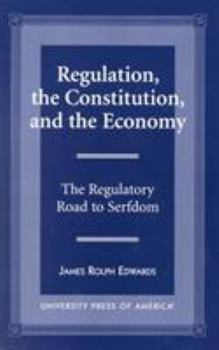
Regulation, The Constitution, and the Economy: The Regulatory Road to Serfdom


Select Format
Select Condition 
Book Overview
Regulation, The Constitution, and the Economy demonstrates the constitutionally degraded and inherently dictatorial character of regulation, its ineffectiveness in curing social ills, and its use as a tool of special interests seeking personal gain in the form of money or power. Regulation became prominent in the late medieval mercantile rent seeking societies, but was little used in the United States until after the Civil War. The author demonstrates the nature of regulation as antithetical to constitutional forms of law, and an antidemocratic franchising of legitimate legislative authority to unelected persons. He provides a history of industry regulation using transportation and public utilities that belies the public interest justification for such regulation and makes its rent-seeking origins clear. The history of social regulation proves less clear, but shows the public harmed more than helped by it, as exhibited through its enormous negative effect on productivity growth and economic activity.
Format:Paperback
Language:English
ISBN:0761812628
ISBN13:9780761812623
Release Date:November 1998
Publisher:University Press of America
Length:256 Pages
Weight:0.65 lbs.
Dimensions:0.5" x 5.0" x 8.0"
Customer Reviews
1 rating
Great Book
Published by Thriftbooks.com User , 22 years ago
My economics prof. assigned this book for a public policy class. I was a little put off at first by some grammatical and spelling deficiencies, but the problems went away and the more I read, the better the book got. Great coverage of the constitutionality of regulations and administrative laws, a short history of American regulation from the early Republic to the late 80's and early 90's, and a rundown of some economic theories of regulation. Some economic knowledge is necessary and there are a few graphs and tables of statistics. Great resource if you want some ammunition to take on your liberal friends and professors.
Copyright © 2026 Thriftbooks.com
Terms of Use | Privacy Policy | Do Not Sell/Share My Personal Information | Cookie Notice | Cookie Preferences | Accessibility Statement
ThriftBooks ® and the ThriftBooks ® logo are registered trademarks of Thrift Books Global, LLC
ThriftBooks ® and the ThriftBooks ® logo are registered trademarks of Thrift Books Global, LLC
