


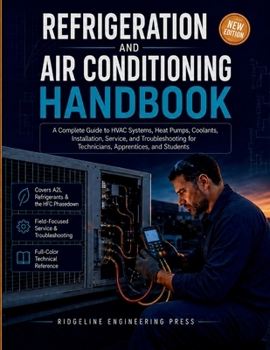
Refrigeration and Air Conditioning Handbook: A Complete Guide to HVAC Systems, Heat Pumps, Coolants, Installation, Service, and Troubleshooting for Technicians, Apprentices, and Students

For most of the twentieth century a technician could learn one refrigerant, learn the pressures that went with it, and carry that knowledge for a working lifetime. That is no longer possible.
The chlorinated fluids were withdrawn. The high global warming potential fluids that replaced them are being withdrawn in turn, and the fluids taking their place are mildly flammable. A cylinder on a truck today may hold a blend of five components with a temperature glide that punishes anyone who charges it as vapour. A rooftop unit installed this year is likely to carry a refrigerant that did not exist commercially when the technician servicing it began an apprenticeship.
Meanwhile the same technician is asked to charge a residential split system, diagnose a communicating control, and work out why a walk-in freezer will not pull down. Procedure-only training fails here, because a procedure works on the system it was written for and a mechanism works on all of them.
This handbook is built on that division. The physics comes first and is treated as permanent. The fluids, the regulations and the equipment come second, and are treated as things to verify rather than memorise; where a rule is likely to change, the principle behind it is given alongside the rule.
What you will take from itThe ability to read a system from two gauges and two thermometers whatever fluid is inside it, including glide, dew point and bubble point, and why superheat is read against one column and subcooling against the other.A diagnostic order that does not change - listen, look, electrical, airflow, refrigerant, confirm - and the reason airflow must be measured before any refrigerant reading is interpreted.The superheat and subcooling grid that places a fault on one side of the metering device, and the pressure patterns that separate a compressor fault from an air-side fault.Airflow measured properly by traverse, flow hood, anemometer, blower table or temperature rise, with external static pressure partitioned among filter, coil, return and supply.Electrical method: voltage in parallel with power on, current clamped around one conductor, resistance on an isolated device with power off - and always the question of what destroyed the component you are replacing.Installation that does not fail later: nitrogen flowing through every brazed joint, a dry-nitrogen pressure test, evacuation to five hundred microns proved by a decay test, and charging by the method the metering device requires.One hundred and sixteen worked examples with every arithmetic step and unit shown, and more than a hundred and forty practice problems answered with the reasoning, not just the result.
Fifteen chapters run from heat and the vapour-compression cycle through working fluids, compressors, heat exchangers, metering devices and piping, then psychrometrics, duct design and airflow, electrical fundamentals and controls, heat pumps, and commercial and industrial refrigeration, closing with installation practice and systematic fault diagnosis. Three appendices give saturation and glide tables, every numbered equation in one place, and a field quick reference of target values, pressure patterns, electrical checks and safety rules. A glossary of roughly one hundred and ninety terms and a full index complete it, with units given in both systems throughout.
It is written for the working technician sent from one generation of equipment to another, the installer whose callbacks begin at commissioning, the apprentice learning the reasons behind the steps, and the trade-school or two-year student with an examination to pass and a first year in the field to survive.
Open it at the first chapter and start building the understanding that outlasts the fluid in the cylinder.
Click the "Buy Now" button to purchase.Customer Reviews
ThriftBooks ® and the ThriftBooks ® logo are registered trademarks of Thrift Books Global, LLC
