


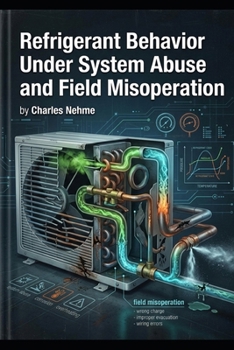
Refrigerant Behavior Under System Abuse and Field Misoperation

Refrigeration and air-conditioning systems are often treated as predictable, almost mechanical utilities-install the equipment, charge the refrigerant, and expect stable operation. In reality, these systems behave more like living thermodynamic environments that respond aggressively to even small deviations in installation, commissioning, or maintenance practices.
This book was written to address a gap that is rarely covered in formal engineering education: what actually happens to refrigerant behavior when systems are abused, misdiagnosed, or incorrectly commissioned in the field.
Overcharging, undercharging, contamination, and improper piping are not theoretical faults. They are daily realities in HVAC practice worldwide. Their consequences are often misunderstood, leading to repeated compressor failures, unstable operation, excessive energy consumption, and premature system degradation-even when equipment is still under warranty.
Rather than focusing on ideal design conditions, this book explores how refrigerants behave under stress conditions and how real systems deviate from textbook assumptions. It connects thermodynamic principles with field behavior, helping the reader understand not just what fails, but why it fails at the refrigerant level.
The goal is practical clarity: to bridge the gap between theory and field reality, and to help engineers, technicians, and facility operators recognize failure patterns before they escalate into costly breakdowns.
Customer Reviews
ThriftBooks ® and the ThriftBooks ® logo are registered trademarks of Thrift Books Global, LLC
