


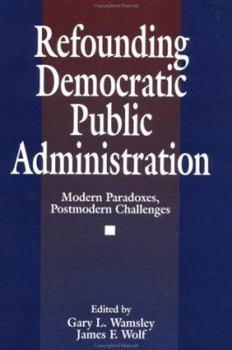
Refounding Democratic Public Administration: Modern Paradoxes, Postmodern Challenges


Select Format
Select Condition 
Book Overview
The American political system is undergoing a serious governmental crisis--our political leaders know only how to campaign, not how to gain consensus on goals or direct a course that is for the good of the nation. Continuing research that began over a decade ago with Gary L. Wamsley′s Refounding Public Administration, this informative new volume continues the argument that public administration is at the center of the governance process and is therefore forced to compensate for the growing inadequacy of our leaders. Refounding Democratic Public Administration offers a revisualization of the relationship between public servants and the citizens they serve, as well as a continuing discourse on how public administration can constructively balance forces of change and stability in order for democracy to evolve and mature. This eye-opening volume will be required reading for students and professionals in public administration, political science, and management/organization studies.
Format:Paperback
Language:English
ISBN:080395977X
ISBN13:9780803959774
Release Date:August 1996
Publisher:SAGE Publications, Incorporated
Length:416 Pages
Weight:1.58 lbs.
Dimensions:0.9" x 7.0" x 10.0"
Customer Reviews
1 rating
How relevant is Blacksburg perspective today?
Published by Thriftbooks.com User , 19 years ago
This book is a sequel to Wamsley, et al, Refounding Public Administration that outlined "Blacksburg perspective" and seeks to "stimulate discourse on matters of fundamental importance to public administration and American polity." It was written in the backdrop of the publication of Reinventing Government by Osborne and Gaebler and subsequent National Performance Review of Clinton Administration, and about half the book is devoted to discussion and critique of `reinventing government', the popularity of which is attributed to general dissatisfaction with governance in US. Or as the author states, "we had come to have serious doubts about America's ability to govern itself unless it developed a new way of thinking about and conducting the activities called public administration" (P 1). The central theme that emerges throughout the book is the authors' assertion that the fundamental problem is "the lack of legitimation for a key component in governance process- public administration" (P 5). Similarly, McSwite notes that "public administration has never adequately come to grips with the problem of finding a legitimate place for itself in the American scheme of democratic government" (P198), which the editors contend can be resolved only by finding "ways to create democratic legitimacy for itself that are not elective in nature." This is for two reasons. It is not enough to have a derivative legitimacy, which means since the public administration is accountable to elected representatives, it automatically becomes democratically legitimate. Second, election is not the only mechanism to earn democratic and constitutional legitimacy. The authors further contend that public administration was the legitimate organ of constitutional government. They use the metaphor of balanced wheel and suggest that public administration is somewhat on the same pedestal as other branches of the government. While there concern for restoring legitimacy and confidence in public administration is justified, there suggestion is fraught with dangers as it is likely to create a professional elite in the same fashion as the other elite groups (eg. Corporations and lobby groups) whose powers authors expressly seek to curtail. I personally like the metaphor of backbone to describe the public administration since it conveys its importance in a democratic polity without undue exaggeration. While the critique of all the papers in the volume is beyond the scope of this review, I would present some of the key ideas and their critique. Green and Hubbell come down heavily on the 10 principles of reinventing government, which are: steering others rather than rowing, empowering customers rather than serving them, intense customer orientation, injecting competition into service delivery, leveraging change through market-based incentives, organizing by mission than by rules, funding results and not inputs, encouraging entrepreneurial earning than bureaucratic spending, focusing on prevent
Copyright © 2026 Thriftbooks.com
Terms of Use | Privacy Policy | Do Not Sell/Share My Personal Information | Cookie Policy | Cookie Preferences | Accessibility Statement
ThriftBooks ® and the ThriftBooks ® logo are registered trademarks of Thrift Books Global, LLC
ThriftBooks ® and the ThriftBooks ® logo are registered trademarks of Thrift Books Global, LLC
