


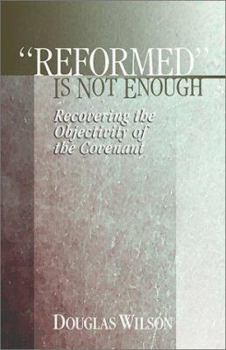
Reformed is Not Enough: Recovering the Objectivity of the Covenant

Select Format
Select Condition 
Book Overview
Membership in the Christian faith is objective-it can be photographed and fingerprinted. In baptism, God names us and imposes gracious obligations upon us. Multitudes of faithless, corrupt Christians... This description may be from another edition of this product.
Format:Paperback
Language:English
ISBN:1591280052
ISBN13:9781591280057
Release Date:October 2002
Publisher:Canon Press
Length:216 Pages
Weight:0.65 lbs.
Dimensions:0.5" x 5.6" x 8.5"
Customer Reviews
5 ratings
True Reformation Theology
Published by Thriftbooks.com User , 19 years ago
Wonderful book! Reading this book has reassured me that there are still some people who are faithful to the historic reformed faith. In times when sacraments are seen as empty signs and covenant is replaced by individualism, a book like this one is very refreshing.
Baptists We Aren't
Published by Thriftbooks.com User , 20 years ago
When I finished this most controversial book, I looked up from its pages and thought, "What's to disagree about? This sounds like what I have always understood to be the reformed faith!" Those that disagree with the book do not understand the high sacramentalism of their own Westminster standards. Wilson says nothing that the Bible, nor the WCF already say. What has happened in the reformed world is this: in the wake of the 2nd Great Awakening, presbyterians lost their high covenant theology for a Zwinglian-Baptistic-pietistic theology that demanded confessions of faith for covenant children and we lost our belief in the efficacy of the sacraments particularly baptism. Wilson's book is sure to charge the pietist mind with loomings of Rome; I would urge those offended to restudy the confession, be converted or go down the street to the local Baptist church and be done with it.
Read The Book, Not the Critiques
Published by Thriftbooks.com User , 20 years ago
Doug Wilson is a bit of lightening rod. Whether it is the good people of Moscow, ID or his fellow Reformed brethren, Wilson has a tendency to cause people to either love him or hate. Personally, I thoroughly enjoy him - it hasn't always been that way, but I had the opportunity to meet him in person and he exemplified Christian humility. He, in a sense, has a Pauline aspect to him and his writing, "strong in letter", although I wouldn't call him weak in person. With that said, I will get into this review: First, please read the book and not simply buy into some of the negative reviews. The reviews I have read, for the most part, are great distortions of the contents of this book. For example, two negative reviews here ("Right-Wing Propaganda" and "A Great Defense of R.C. Theology") are completely misguided. So, if someone claims that Wilson believes in "baptismal regeneration" or absolutizes the statement "Christians can fall away" demonstrates that they have not read Wilson charitably, but looking to find fault and responding merely to words rather than the argument. Within the context of this book, his language is clear. Next, this book has nothing to do with "right-wing" anything. Please, please, please read the book. Second, the contents: In Part I, in order to lay the ground work, Wilson goes through the "Bona Fides" (Calvinistic, Evangelical, Reformation, Tradition & Systematics, & Individualism). Anyone that believes Wilson denies "justification by faith alone", "Calvinism", or thinks he believes in "baptismal regeneration" simply has not read this section closely. He clearly holds to the WCF respecting the sovereignty of God and imputation of Christ's righteousness. Part II delves into the "Covenant, Church, & Sacraments". I wish he would tweak certain things here and there, but as an introduction to the "objectivity of the covenant", this section serves as a suitable helper, especially reintroducing many within the Church to the Reformational view of the sacraments (not sacerdotalism). Part III covers "Apostasy and Assurance". Here he discusses Assurance, Apostasy, Heretics and the Covenant, Sons of Belial, False Brothers, Blessings and Curses. This is an important section, because he helps with many of the practical implications of the "objectivity of the covenant", which "Reformed", as usually set up as simply 5 points, will often break down. The fourth and final section discusses "Faith and Good Works". This section will assure anyone that believes he denies justification by "faith alone", and will cause the Reformed, which are often too influenced by Luther hermeneutic, to rejoice in the Torah of the Lord. He ends the book with a brief critique of the "New Perspective on Paul", which is often accused of being a part of. This should make that point moot, but since enough people have said he is, it has some sticking power. Third, acquire the book and read it for yourself. The Scriptures, I believe, are ope
Tremendous Book on the Objectivity of the Covenant
Published by Thriftbooks.com User , 22 years ago
This is a great work that needs to be read by everyone who submits to the Westminster Confession. As the previous reviewer stated, for too long Presbyterians have comprised and essentially become Baptists. For instance, many of the Southern Presbyterians viewed our children just liked the rest of the unconverted! This is not traditional Reformed teaching, and I am glad to see Wilson (who is an ex-Baptist, by the way) counter this. Wilson goes on to show that real apostasy happens in the covenant. This is a very controversial topic, but it is one that needs to be discussed. The analogy of the husband is amazing, and it goes to show how that baptized "Christians" who are in heresy or licentious living are adulterating the Covenant for which the were brought into! It is not that they never were *really* in the Covenant, but the fact that they were is what makes their actions so horrendous. Wilson also does a great job to show that there is much more to "Covenant" than individual election. This is the view of Baptists and many Presbyterians, but is not historic Reformed teaching. We cannot see election, but we can see Covenant. This is why the Covenant is objective, and everyone who receives Trinitarian baptism is brought into the New Covenant and is objectively a Christian. Some say that Wilson is denying the perseverance of the saints. This is not at all the case, however. He plainly states that it is by grace that we persevere. Many people are reading Wilson with a "Hermeneutics of Suspicion", and see what they want to see. The appendix on the New Perspective is very short, so it didn't adequately deal with the topic, however, it wasn't intended to be an in depth response. It was intended to show that he is not an advocate of the New Perspective as the RPCUS erroneously contended. Another aspect of the book that is excellent is his critique of the language of the "visible and invisible" church of the Westminster Confession. He opts for more Redemptive-Historical terminology with the "historic and the eschatological" church. This is more biblical theologically informed than the "visible and invisible church" terminology. This is a terrific book, and needs to be read by everyone who loves the Reformed faith. We need to realize that the Reformed faith is not centered around TULIP, but around Covenant. Many contemporary "Reformed" have compromised historic Reformed teaching. Thank you Doug Wilson for showing us that.
Westminster Lives!
Published by Thriftbooks.com User , 22 years ago
For far too long, the richness of the reformed faith has been smothered by those who would make us Baptists. As a PCA presbyterian, I believe (with only a few exceptions) that the Westminster Confession fo Faith is a true and accurate representaion of what the Bible says about providence, salvation, the Church, etc. This naturally includes the sacraments. In addressing this topic, our confession says that Baptism is "a sign and seal of the covenant of grace, of his ingrafting into Christ, of regeneration, of remission of sins, and of his giving up unto God through Jesus Christ, to walk in newness of life." The Confession clearly teaches that Baptism is more than just a symbol, but an actual means of grace. Without being superstitious about it, we believe that baptism saves (1 Pet. 3:21). We don't beleive that there is magic in the water, or that baptism works "ex opere operato", but we do believe it does something. Given that, Wilson makes the case for the idea that a "Christian" can be cut off from Christ and lost for all eternity. Before he does so, however, he is very careful to affirm the 5 points of the Synod of Dordt, stressing that he still believes in unconditional election and in the perseverance of the saints. His point is that those who are part of the Church, but not elect from before the foundation of the world, are still genuine parts fo the church, covenentally attached to Christ, and are subsequently cast off for all eternity. In short, he makes a compelling case for the fifteenth chapter of John. Wilson redefines the word "Christian" to include all those who have been baptized in the name of the triune God. This is far more consistent with Scripture, which uses the word Christian only 3 times, always in an objective sense. (Acts 11:26, Acts 26:28, 1 Pt. 4:16). His comparison of the word "Christian" to the word "husband" is brilliant. He draws the following parallel: If a husband is cheating on his wife, is he still a husband? Of course he is. In fact, that is what makes his actions so wrong! In discussing an adulterous husband, no one would say, "Well, at least he's married!", or "He isn't really married.". Being married is what makes his crime so disturbing. Likewise, if a person is covenentally attached to Christ through baptism, calling them a Christian simply describes the nature of the covenental relationship, not whether or not the person is being faithful. Someone who is adulterous in their relationship to Christ is still a "christian" in the objective sense. In fact, that is why their actions are so disturbing. If we say that Lesbian bishops are not "Christians", we have given up the means by which we may charge them as heretics. Wilson's book made me think like few others have. A warning is in order, however: If you are a Baptist, Campbellite, etc., you will not agree with a word in this book. If you are a presbyterian who believes his own confession, you should agree wholeheartedly with nearly every word.
Copyright © 2026 Thriftbooks.com
Terms of Use | Privacy Policy | Do Not Sell/Share My Personal Information | Cookie Policy | Cookie Preferences | Accessibility Statement
ThriftBooks ® and the ThriftBooks ® logo are registered trademarks of Thrift Books Global, LLC
ThriftBooks ® and the ThriftBooks ® logo are registered trademarks of Thrift Books Global, LLC
