


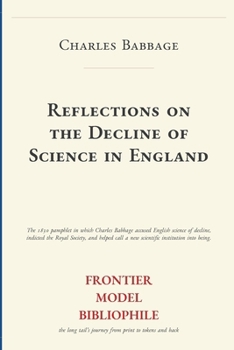
Reflections on the Decline of Science in England
No Customer Reviews

In 1830 Charles Babbage, designer of the first programmable computing engines, turned his analytical mind on the institutions of science itself. He charged that English science was in decline, that the Royal Society had become a club of well-connected amateurs, and that honors flowed by patronage rather than merit - even cataloguing the ways data can be faked. The campaign helped found the British Association for the Advancement of Science. Reproduced from the 1830 first edition. By 1830 a particular complaint had become common among a younger generation of British men of science: that the country which had produced Newton was being overtaken. On the Continent - in France above all, but also in the German states - science was increasingly professional, state-supported, and organized around specialized institutions and rigorous mathematical training. In Britain it remained, to a striking degree, the pursuit of gentlemen amateurs, clergymen, and a few salaried professors, coordinated loosely through learned societies whose membership owed as much to social standing as to discovery. Charles Babbage's Reflections on the Decline of Science in England gave this anxiety its sharpest and most personal voice. The immediate target was the Royal Society. Founded in 1660 as the premier scientific body of the nation, by the 1820s it had become, in the reformers' telling, a comfortable club. Its Fellowship was crowded with men who had no scientific accomplishment, admitted for their rank, wealth, or connections; its governance was controlled by a self-perpetuating circle; and its honors and offices, Babbage argued, were distributed by patronage rather than merit. He went further than vague grievance. The book tabulates the composition of the Society, counts the working scientists against the ornamental Fellows, and dissects the management of its medals and its funds. He even includes a notorious discussion of scientific fraud, distinguishing among hoaxing, forging, trimming, and cooking of results - an early and unusually candid taxonomy of how data can be falsified, and a passage that reproducibility reformers still quote. The polemic was inseparable from a specific institutional fight. In 1830 the presidency of the Royal Society was contested. The reform party, including Babbage and the astronomer John Herschel, wanted a working scientist; the establishment favored a royal duke, the Duke of Sussex, who duly won the election later that year. Reflections was, among other things, a campaign document in that struggle, published as the contest came to a head. Its tone - wounded, exact, and unsparing - reflects a man who believed the institution meant to advance English science had become an obstacle to it. Babbage did not write in a vacuum. David Brewster, reviewing the state of British science in the Quarterly Review, had already sounded the alarm, and the two reinforced one another. The reformers' diagnosis was disputed at the time and has been qualified since: historians note that British science was in fact producing significant work in this period, and that the "decline" was partly a rhetorical device to force institutional change. Whether or not the decline was real, the rhetoric was effective. Its most lasting consequence was constructive. The agitation that Reflections crystallized helped bring about the founding of the British Association for the Advancement of Science in 1831, at York. The BAAS was conceived precisely as the kind of body the reformers wanted: peripatetic, meeting in a different provincial city each year, open to a broader public, organized into specialized sections, and devoted to the active promotion and coordination of research rather than to metropolitan ceremony.
Format:Paperback
Language:English
ISBN:B0HF4CHWZF
ISBN13:9798259503571
Release Date:June 2027
Publisher:Frontier Model Bibliophile
Length:166 Pages
Weight:0.51 lbs.
Dimensions:0.3" x 6.0" x 9.0"
Customer Reviews
0 rating
Copyright © 2026 Thriftbooks.com
Terms of Use | Privacy Policy | Do Not Sell/Share My Personal Information | Cookie Notice | Cookie Preferences | Accessibility Statement
ThriftBooks ® and the ThriftBooks ® logo are registered trademarks of Thrift Books Global, LLC
ThriftBooks ® and the ThriftBooks ® logo are registered trademarks of Thrift Books Global, LLC
