


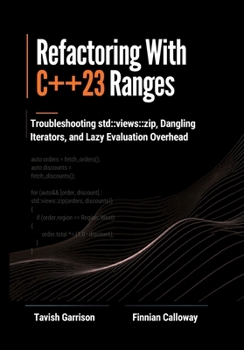
Refactoring With C++23 Ranges: Troubleshooting std::views::zip, Dangling Iterators, and Lazy Evaluation Overhead (The C++ Field Guide Series)
No Customer Reviews

Your Range Pipeline Compiled Clean. It's Still Wrong.
A loop refactored to std:: views:: zip can pass every test in your suite, get approved in review, and still pair the wrong bonus with the wrong employee in production, silently, for weeks, because nothing about a valid iterator tells you the range next to it just went out of sync.
Most engineers treat a clean compile and a green test suite as proof that a range pipeline is correct. It rarely is. A view holding a reference into a temporary compiles without a diagnostic and dangles the instant the function that built it returns. A const auto& on a zip structured binding looks like it blocks mutation and doesn't, because the binding declarator was never what controlled that. A filtered view handed to three "reusable" helper functions re-runs its predicate three full times, at full cost, because a view has no memory of the traversal that just happened one line above it.
Refactoring With C++23 Ranges is not an introduction to ranges or to the standard library. It is a strictly technical, mechanism-first field guide for C++ engineers who already write range-based pipelines and need to diagnose, not guess at, why a refactor that compiled cleanly produced a wrong answer, a dangling reference, or a benchmark that doesn't match what the code should cost.
Through precise lifetime reasoning, production-grade code, and traced execution order, you will learn to confirm what your pipeline actually does instead of what its syntax implies, and to catch a dangling range or a desynced zip before it ships instead of after a customer reports it.
Inside the Book, You Will Diagnose and Fix:
Dangling Views: Trace exactly which source ranges outlive their views and which don't, including the specific C++23 lifetime-extension rule that protects one narrow syntactic case and none of the others.
zip Mutation Traps: Learn what actually controls mutability through a std:: views:: zip binding (the source range's const-qualification, not the structured binding's declarator), and stop shipping "read-only" code that isn't.
Silent Truncation: Recognize when zip is quietly stopping at your shortest source range instead of erroring, and build the length checks that catch a desynced pair before it corrupts a calculation.
Cross-Range Desync: Diagnose the specific failure where mutating one zipped range while leaving another untouched breaks positional correspondence with no invalid iterator and no sanitizer warning anywhere in sight.
Iterator Invalidation Mid-Pipeline: Know exactly which container operations invalidate a view's iterators mid-traversal, and build the deferred-mutation pattern that keeps a structural change from corrupting a live pipeline.
Repeated Evaluation Cost: Count consumers before you count elements, and materialize a lazy pipeline at the exact point multiple traversals turn a cheap predicate into a three or four times multiplied cost nobody budgeted for.
Stop trusting a compiling pipeline or a passing test suite as proof your ranges code is doing what it looks like it's doing. Whether you're auditing an inherited codebase mid-migration to ranges or writing a new pipeline from scratch, this book gives you the exact reasoning, code, and review checklist to know the difference between idiomatic and correct.
Who this book is for: senior C++ engineers, systems developers, and technical leads who already write or review range-based C++ and need to move from "it compiles and passes tests" to actually verifying lifetime, mutation, and evaluation-cost correctness in a std:: ranges pipeline. It assumes working knowledge of modern C++. It is not an introduction to ranges for beginners.
Scroll up and click "Buy Now" to catch your dangling ranges and desynced pipelines before production data finds them for you.
A loop refactored to std:: views:: zip can pass every test in your suite, get approved in review, and still pair the wrong bonus with the wrong employee in production, silently, for weeks, because nothing about a valid iterator tells you the range next to it just went out of sync.
Most engineers treat a clean compile and a green test suite as proof that a range pipeline is correct. It rarely is. A view holding a reference into a temporary compiles without a diagnostic and dangles the instant the function that built it returns. A const auto& on a zip structured binding looks like it blocks mutation and doesn't, because the binding declarator was never what controlled that. A filtered view handed to three "reusable" helper functions re-runs its predicate three full times, at full cost, because a view has no memory of the traversal that just happened one line above it.
Refactoring With C++23 Ranges is not an introduction to ranges or to the standard library. It is a strictly technical, mechanism-first field guide for C++ engineers who already write range-based pipelines and need to diagnose, not guess at, why a refactor that compiled cleanly produced a wrong answer, a dangling reference, or a benchmark that doesn't match what the code should cost.
Through precise lifetime reasoning, production-grade code, and traced execution order, you will learn to confirm what your pipeline actually does instead of what its syntax implies, and to catch a dangling range or a desynced zip before it ships instead of after a customer reports it.
Inside the Book, You Will Diagnose and Fix:
Dangling Views: Trace exactly which source ranges outlive their views and which don't, including the specific C++23 lifetime-extension rule that protects one narrow syntactic case and none of the others.
zip Mutation Traps: Learn what actually controls mutability through a std:: views:: zip binding (the source range's const-qualification, not the structured binding's declarator), and stop shipping "read-only" code that isn't.
Silent Truncation: Recognize when zip is quietly stopping at your shortest source range instead of erroring, and build the length checks that catch a desynced pair before it corrupts a calculation.
Cross-Range Desync: Diagnose the specific failure where mutating one zipped range while leaving another untouched breaks positional correspondence with no invalid iterator and no sanitizer warning anywhere in sight.
Iterator Invalidation Mid-Pipeline: Know exactly which container operations invalidate a view's iterators mid-traversal, and build the deferred-mutation pattern that keeps a structural change from corrupting a live pipeline.
Repeated Evaluation Cost: Count consumers before you count elements, and materialize a lazy pipeline at the exact point multiple traversals turn a cheap predicate into a three or four times multiplied cost nobody budgeted for.
Stop trusting a compiling pipeline or a passing test suite as proof your ranges code is doing what it looks like it's doing. Whether you're auditing an inherited codebase mid-migration to ranges or writing a new pipeline from scratch, this book gives you the exact reasoning, code, and review checklist to know the difference between idiomatic and correct.
Who this book is for: senior C++ engineers, systems developers, and technical leads who already write or review range-based C++ and need to move from "it compiles and passes tests" to actually verifying lifetime, mutation, and evaluation-cost correctness in a std:: ranges pipeline. It assumes working knowledge of modern C++. It is not an introduction to ranges for beginners.
Scroll up and click "Buy Now" to catch your dangling ranges and desynced pipelines before production data finds them for you.
Format:Paperback
Language:English
ISBN:B0HGKKP86X
ISBN13:9798194763511
Release Date:August 2026
Publisher:Independently published
Length:144 Pages
Weight:0.54 lbs.
Dimensions:9.6" x 0.3" x 6.7"
Customer Reviews
0 rating
Copyright © 2026 Thriftbooks.com
Terms of Use | Privacy Policy | Do Not Sell/Share My Personal Information | Cookie Policy | Cookie Preferences | Accessibility Statement
ThriftBooks ® and the ThriftBooks ® logo are registered trademarks of Thrift Books Global, LLC
ThriftBooks ® and the ThriftBooks ® logo are registered trademarks of Thrift Books Global, LLC
