


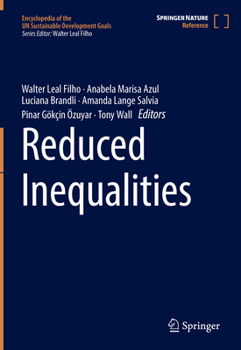
Reduced Inequalities
No Customer Reviews

The problems related to the process of industrialisation such as biodiversity depletion, climate change and a worsening of health and living conditions, especially but not only in developing countries, intensify. Therefore, there is an increasing need to search for integrated solutions to make development more sustainable. The United Nations has acknowledged the problem and approved the "2030 Agenda for Sustainable Development". On 1st January 2016, the 17 Sustainable Development Goals (SDGs) of the Agenda officially came into force. These goals cover the three dimensions of sustainable development: economic growth, social inclusion and environmental protection.
The Encyclopedia of the UN Sustainable Development Goals comprehensively addresses the SDGs in an integrated way. The Encyclopedia encompasses 17 volumes, each one devoted to one of the 17 SDGs. This volume addresses SDG 10, namely "Reduce inequality within andamong countries", but also includes inequalities in income as well as those based on age, sex, disability, race, ethnicity, origin, religion or economic or other status within a country. The Goal also addresses inequalities among countries, including those related to representation, migration and development assistance. This volume contains the description of a range of terms, to allow a better understanding and foster knowledge about it.
Md. Mahmudul Alam, Olga Bialostocka, Jos Baltazar Salgueirinho Os rio de Andrade Guerra, Narasimha Reddy Donthi, Ulla A. Saari, Daniele Vieira, Amanda Lange Salvia
The Encyclopedia of the UN Sustainable Development Goals comprehensively addresses the SDGs in an integrated way. The Encyclopedia encompasses 17 volumes, each one devoted to one of the 17 SDGs. This volume addresses SDG 10, namely "Reduce inequality within andamong countries", but also includes inequalities in income as well as those based on age, sex, disability, race, ethnicity, origin, religion or economic or other status within a country. The Goal also addresses inequalities among countries, including those related to representation, migration and development assistance. This volume contains the description of a range of terms, to allow a better understanding and foster knowledge about it.
Concretely, the identified targets are:
Progressively achieve and sustain income growth of the bottom 40 per cent of the population at a rate higher than the national averageEmpower and promote the social, economic and political inclusion of all, irrespective of age, sex, disability, race, ethnicity, origin, religion or economic or other statusEnsure equal opportunity and reduce inequalities of outcome, including by eliminating discriminatory laws, policies and practices and promoting appropriate legislation, policies and action in this regardAdopt policies, especially fiscal, wage and social protection policies, and progressively achieve greater equalityImprove the regulation and monitoring of global financial markets and institutions and strengthen the implementation of such regulationsEnsure enhanced representation and voice for developing countries in decision-making in global international economic and financial institutions in order to deliver more effective, credible, accountable and legitimate institutionsFacilitate orderly, safe, regular and responsible migration and mobility of people, including through the implementation of planned and well-managed migration policiesImplement the principle of special and differential treatment for developing countries, in particular least developed countries, in accordance with World Trade Organization agreementsEncourage official development assistance and financial flows, including foreign direct investment, to states where the need is greatest, in particular least developed countries, African countries, small island developing states and landlocked developing countries, in accordance with their national plans and programmesReduce to less than 3 per cent the transaction costs of migrant remittances and eliminate remittance corridors with costs higher than 5 per centEditorial BoardMd. Mahmudul Alam, Olga Bialostocka, Jos Baltazar Salgueirinho Os rio de Andrade Guerra, Narasimha Reddy Donthi, Ulla A. Saari, Daniele Vieira, Amanda Lange Salvia
Format:Hardcover
Language:English
ISBN:331995881X
ISBN13:9783319958811
Release Date:August 2021
Publisher:Springer
Length:924 Pages
Weight:4.60 lbs.
Dimensions:1.9" x 8.1" x 10.2"
Customer Reviews
0 rating
Copyright © 2026 Thriftbooks.com
Terms of Use | Privacy Policy | Do Not Sell/Share My Personal Information | Cookie Notice | Cookie Preferences | Accessibility Statement
ThriftBooks ® and the ThriftBooks ® logo are registered trademarks of Thrift Books Global, LLC
ThriftBooks ® and the ThriftBooks ® logo are registered trademarks of Thrift Books Global, LLC
