


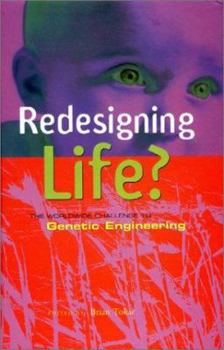
Redesigning Life?: The Worldwide Challenge to Genetic Engineering

Select Format
Select Condition 
Book Overview
New discoveries in biotechnology are often touted as the answer to many contemporary problems. Genetic engineering, animal cloning, and reproductive technologies are promoted as the keys to a brighter... This description may be from another edition of this product.
Format:Hardcover
Language:English
ISBN:1856498344
ISBN13:9781856498340
Release Date:May 2001
Publisher:Zed Books
Length:384 Pages
Weight:1.55 lbs.
Dimensions:9.3" x 1.3" x 6.3"
Customer Reviews
5 ratings
Wide-ranging and effective critique of genetic engineering
Published by Thriftbooks.com User , 24 years ago
You may have heard the biotech industry's claims that genetic engineering (GE) is the key to eradicating hunger, improving the environment, and helping humans live healthier lives. Yet, many people have resisted the adoption of these technologies (mainly in Europe but increasingly in the U.S.). Do these protests have validity? This excellent book convincingly argues that Yes, the public should be concerned about GE. Its 31 essays are written by an assortment of knowledgeable but concerned scientists and activists. Some of them are ex-industry insiders who clearly understand the technical issues involved. These writers resoundingly dispel the industry's usual claim that GE dissenters are uninformed neo-Luddites.It is clear that the biotech industry exists principally to make money for its investors. Statements about making the world a better place are, in fact, little more than a public relations smoke screen but have been effective in that it gives cover for politicians and regulators who must approve much of what the industry does. It is a bit surprising that most people are not more concerned about the ownership of life forms (including human DNA) by private companies. To date, this has mostly affected farmers who are impelled to buy patent-protected seed, but in the future it may have profound implications for most people too. Several essays drill into this particular topic in detail, and are eye-opening.Other articles focus on the many serious technical concerns that exist, such as the threat of cross-pollination. It is alarming to learn that companies such as Monsanto push aggressively to get new products approved, despite evidence that they may be dangerous. The book also suggests common sense solutions to many of the problems that the biotech industry claims to be solving. For example, instead of growing GE pigs to produce replacement human body parts, why not simply encourage more people to participate in organ donor programs? If participation rates were increased in the U.S. to levels comparable to some other places in the world, there would be no shortage. If you want to be better informed about the vitally important topic of GE, I strongly encourage you to read this book.
Must be read...
Published by Thriftbooks.com User , 24 years ago
'This book explains why and how genetic engineering is adversely affecting our food, health, environment and human rights. It also shows what people are doing to counter the technology and the industry. It must be read by the public everywhere and by policymakers, especially in developing countries.' - Martin Khor, Director, Third World Network
Relief to the Brave New World
Published by Thriftbooks.com User , 24 years ago
At our think tank we have watched a rather unfortuante level of triumphalism to the new genetic technologies. From Dolly to Rael to boistrous Italians and to "experts" at the American Academy for the "Advancement" of Science (AAAS) far too many individuals and institutions have staked a supportive claim for the new biotechnologies. What these modern Huxley's fail to do, however, is locate biotechnology in a clear political-economic, and historical context. For most of these John-come-lately's (the antedeluvian, US President included) biotechnologies happen in the ever present now. Such experts provide little to no understanding of the deep historical relationship of the "new" technologies to their legacy with the global eugenics movement--that always includes Nazi racial-hygiene efforts. Finally, Brian Tokar and his colleagues have arrived. Not with a venegenace, but with a calm, much needed, political-economic, historical and analytical insight, to be both appreciated and championed.This book is important inasmuch as it contains a critical ad-mixture of prominent environmentalists from the North (e.g., a Director of the quasi-rightwing, xenophobic Sierra Club--that recently voted (unsuccesfully) to ban immigrants from the US) and the South (Vandana Shiva, acclaimed Indian scientists and activists for biosafety and much else) and many others that don't come out screaming. Beyond the enviro-authors are many other scientists and activists many broadly published and read elsewhere. The environmentalists contribution is notable and important inasmuch, despite the anti-GE-food movement they have spawned, environmentalists and other liberals would arguably be the first in line to receive the new genetic technologies, as few if any of these middle to upper-middle class liberals (Heller, Schmidt, Dorsey, et. al.) and global jet-setters (Shiva, Burrows, Von Weisacker, et. al.) would want to "produce" feeble-minded children to attend to the Harvard and Yale factories.More importantly these folks make the point over and over again that biotechnology, as all technologies, just does NOT just happen out of some benevolent transnational ether, to "save the planet" or "cure diseases". Instead interested parties, Monsanto and its underlings, and a host of others, are out to make money. Of course nothing is inherently wrong with making money (despite liberal angst against it), yet when we understand biotech in this light, we are forced to see it for what its worth and to whom.So Redesigning Life is a very important contribution--especially in an age where anyone who dares tell the truth about the thuggery of Monsanto, the potential dangerous and unethical outcomes of Rael or the deadly consequence of GE food may face unwarranted attacks from those that would dare and be able to differ, if only with their huge budgets and fat pockets.The books other bonus is that each chapter can be consumed one part at a time, in any order. Although overall the text is a
Excellent and wideranging coverage of this complex subject
Published by Thriftbooks.com User , 24 years ago
'The biotechnology industry has taken us beyond natural evolution into the unknown terrain of a never-to-be-natural-again world. We know nothing of the long-term biological, ecological, economic, public health and animal welfare impacts of this new technology. This book, with its excellent and wide-ranging coverage of this complex subject, will help us awaken to the costs and potentially harmful, even catastrophic, consequences.' - Dr. Michael W. Fox, Senior Scholar, Bioethics, The Humane Society of the United States, Washington, DC
An excellent starting point
Published by Thriftbooks.com User , 24 years ago
'Biotechnology is truly revolutionary. But it is far from a precise science and the alliance of government, industry and universities to profit from genetic engineering has resulted in extravagant claims of benefits that are highly speculative. This book provides a welcome perspective that is missing from all the biotechnology hype. For anyone concerned about the real implications and potential hazards of gene manipulation, it is an excellent starting point.' - David Suzuki
Copyright © 2026 Thriftbooks.com Terms of Use
| Privacy Policy | Do Not
Sell/Share My Personal Information | Cookie Policy | Cookie Preferences | Accessibility Statement
ThriftBooks® and the ThriftBooks® logo are registered trademarks of Thrift Books Global, LLC
ThriftBooks® and the ThriftBooks® logo are registered trademarks of Thrift Books Global, LLC
