


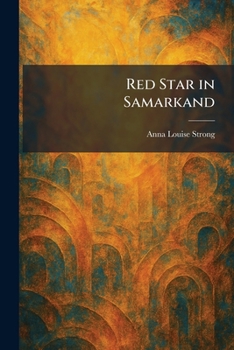
Red Star in Samarkand

Select Format
Select Condition 
Book Overview
"Red Star in Samarkand" is a vivid firsthand account of the transformative changes sweeping through Central Asia during the early years of Soviet rule. Renowned journalist Anna Louise Strong takes readers on a journey through the ancient cities of Uzbekistan, including Samarkand, Bukhara, and Tashkent, documenting a society in the midst of a radical political and social overhaul. The work captures the dramatic tension between centuries-old Islamic traditions and the newly established Bolshevik ideology.
Strong focuses heavily on the social revolutions of the late 1920s, particularly the liberation of women and the movement to discard the veil. Through her observations, she details the industrialization of the region, the establishment of collective farms, and the secularization of education and law. This narrative serves as both a historical record and a travelogue, offering a unique Western perspective on the expansion of Soviet influence into the East. "Red Star in Samarkand" remains a significant resource for understanding the geopolitical and cultural shifts that shaped modern Central Asia, highlighting the complex intersection of tradition, religion, and revolutionary fervor.
This work has been selected by scholars as being culturally important, and is part of the knowledge base of civilization as we know it. This work was reproduced from the original artifact, and remains as true to the original work as possible. Therefore, you may see the original copyright references, library stamps (as most of these works have been housed in our most important libraries around the world), and other notations in the work.
This work is in the public domain in the United States of America, and possibly other nations. Within the United States, you may freely copy and distribute this work, as no entity (individual or corporate) has a copyright on the body of the work.
As a reproduction of a historical artifact, this work may contain missing or blurred pages, poor pictures, errant marks, etc. Scholars believe, and we concur, that this work is important enough to be preserved, reproduced, and made generally available to the public. We appreciate your support of the preservation process, and thank you for being an important part of keeping this knowledge alive and relevant.
Customer Reviews
ThriftBooks® and the ThriftBooks® logo are registered trademarks of Thrift Books Global, LLC
