


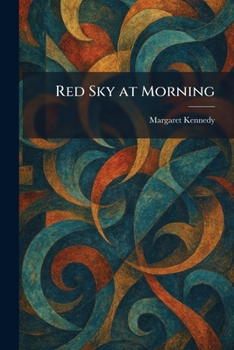
Red Sky at Morning

"Red Sky at Morning" is a compelling exploration of the inescapable weight of family legacy and the fragile nature of innocence. Set against the backdrop of post-World War I England, the novel follows the lives of William and Emily Crowne, the children of a notorious poet whose scandalous life and subsequent trial for murder have left them marked by society. Seeking refuge from the public eye, the siblings retreat to a country estate, attempting to forge their own paths amidst a circle of eccentric friends and bohemian artists.
However, the shadow of their father's past looms large, threatening to repeat history as they navigate complex relationships and the pressures of their inheritance. Margaret Kennedy's masterful prose captures the tension between the desire for personal freedom and the deterministic forces of one's upbringing. A poignant and atmospheric work, "Red Sky at Morning" examines the intersections of art, morality, and the search for identity in a world still reeling from upheaval. This evocative narrative remains a significant contribution to early 20th-century British literature, offering a deep psychological portrait of characters caught between two eras.
This work has been selected by scholars as being culturally important, and is part of the knowledge base of civilization as we know it. This work was reproduced from the original artifact, and remains as true to the original work as possible. Therefore, you may see the original copyright references, library stamps (as most of these works have been housed in our most important libraries around the world), and other notations in the work.
This work is in the public domain in the United States of America, and possibly other nations. Within the United States, you may freely copy and distribute this work, as no entity (individual or corporate) has a copyright on the body of the work.
As a reproduction of a historical artifact, this work may contain missing or blurred pages, poor pictures, errant marks, etc. Scholars believe, and we concur, that this work is important enough to be preserved, reproduced, and made generally available to the public. We appreciate your support of the preservation process, and thank you for being an important part of keeping this knowledge alive and relevant.
Customer Reviews
ThriftBooks® and the ThriftBooks® logo are registered trademarks of Thrift Books Global, LLC
