


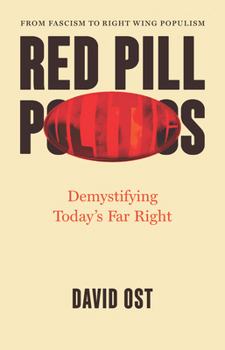
Red Pill Politics: Demystifying Today's Far Right

A smart and accessible dissection of twenty-first-century fascist politics, providing general readers with the tools to understand, and defeat, today's resurgent far right
"Fascism is the term that is everywhere and nowhere in contemporary political discussions." --David Ost
Around the globe, far-right political parties and movements are on the march, stoking fears of the revival of fascism. What to make of this dangerous drift?
In this masterly examination of far-right politics past and present, political scientist David Ost argues that in order to resist its revival, we must understand its often broad appeal, particularly to non-elites who have traditionally aligned with the Left. Ost shows that equating fascism only with violence and mass repression misses its distinctive populist elements, and thus keeps us from recognizing the dangers of a contemporary Right that, for now, downplays its repressive dimensions.
Drawing on a wide range of contemporary and historical examples, Ost argues that both classic fascism and today's right-wing populism should be seen as different versions of what he calls Red Pill Politics. Both promote authoritarian politics, intolerance, xenophobic outrage, and rigid gender roles. Yet they win support by speaking for the dissatisfied with anti-elitist rhetoric, while underemphasizing their repressive policies. They have their best chance of winning when the Left is failing.Red Pill Politics draws on meticulous historical research and deep familiarity with current global developments to present a startlingly original analysis that helps us understand and challenge today's most pressing political threat.
Customer Reviews
ThriftBooks® and the ThriftBooks® logo are registered trademarks of Thrift Books Global, LLC
