


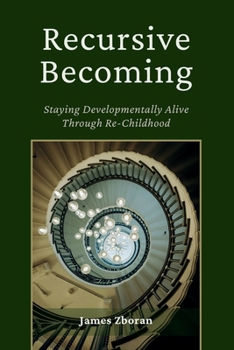
Recursive Becoming: Staying Developmentally Alive Through Re-Childhood

Most people don't stop growing because they run out of potential. They stop because they mistake stability for arrival.
Recursive Becoming is a book about what actually happens when a capable, accomplished adult senses that life is thinning, not dramatically, not through failure, but through a quiet contraction of aliveness that feels, from inside, almost indistinguishable from earned maturity. The problem isn't decline. It's developmental arrest disguised as completion.
James Zboran identifies twelve core human capacities (including sense-making, emotional range, agency, identity fluidity, and the ability to learn without threat) that are formed in childhood and must be periodically renewed throughout life. When they aren't, experience becomes mechanical. Competence deepens in narrow domains while adaptability quietly contracts. The person continues functioning, often successfully, while something essential slowly goes out.
The solution is what Zboran calls re-childhood: the deliberate, voluntary re-entry into genuine beginnerhood in unfamiliar domains. Not reinvention. Not self-improvement. Not the performance of youthfulness. Re-childhood is the practice of growing sideways into new territory so that the underlying capacities for growth, the ones that made early development possible in the first place, remain alive and renewable at any age.
This is not a program with instructions to follow. It is a model to be inhabited. Zboran maps the architecture of how development actually stalls, why it stalls invisibly, and how each of the twelve capacities can be renewed without crisis, without abandoning what has already been built, and without pretending that accumulated experience doesn't exist. The result is aging without narrowing: a life that grows deeper across decades rather than thinner.
Recursive Becoming is for people who have built real competence, deepened real expertise, and established themselves in the world, and who sense, sometimes quietly, that accumulation alone is no longer sustaining what it once did. It offers what very few books on adult development actually deliver: a clear account of why vitality fades when development stops, and a practical model for keeping development genuinely alive.
Youthfulness, properly understood, is not energy or appearance. It is plasticity: the capacity to learn, adapt, and remain responsive to life as it actually unfolds. That capacity can deepen over time rather than diminish. This book shows how.
Customer Reviews
ThriftBooks ® and the ThriftBooks ® logo are registered trademarks of Thrift Books Global, LLC
